

Revenue Integrity & Financial Performance
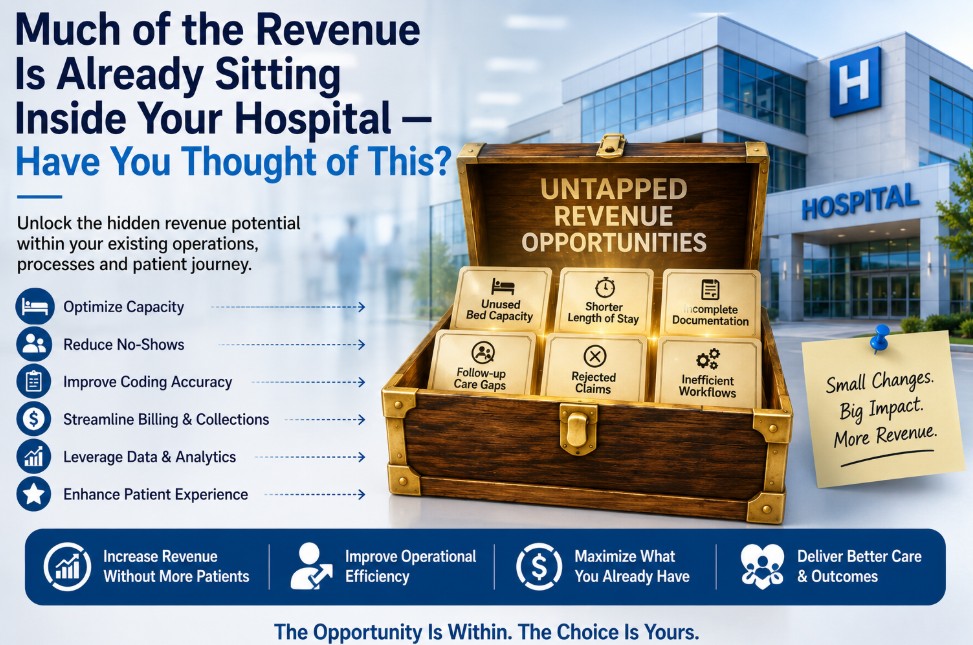
Before the next marketing push, the next service line expansion, the next volume-growth initiative — look inside. The revenue recovery opportunity hiding in plain sight within most hospitals is larger, faster, and far less capital-intensive than anything on the growth agenda.
Every hospital I have worked with in the last thirteen years has launched at least one initiative to grow revenue by acquiring more patients. Very few have conducted a rigorous audit of how much revenue they are generating from the patients they already have — and how much of it is silently evaporating before it ever reaches the balance sheet.
This blog is about that second question. It is a question that makes finance teams uncomfortable, because the honest answer implies that the organization has been leaving significant money on the table — not through negligence, but through the accumulated consequence of fragmented workflows, inadequate documentation culture, undertrained staff, and revenue cycle systems that were never designed to catch what they are missing.
I want to make the case — grounded in operational observation, not theoretical modeling — that for most hospitals, the single highest-return financial initiative available right now is not a new marketing campaign, a new service line, or a new payer contract negotiation. It is a structured, systematic effort to recover the revenue that is already embedded in the care being delivered, and currently leaking out through half a dozen well-documented, fixable gaps.
Why this revenue is invisible — and why that is not an accident
Revenue leakage in hospitals is structurally invisible for a specific reason: it does not appear as a loss on any report. It appears as the absence of revenue that was never claimed, never coded, never documented, or never successfully collected. You cannot see what was never recorded. And because no single report shows you the gap between what you delivered and what you captured, the leakage persists — quarter after quarter, year after year — while leadership focuses on the revenue it can measure: volume, payer mix, average length of stay, denial rate on submitted claims.
The denial rate on submitted claims is instructive as a metaphor. A hospital that tracks its denial rate is measuring what happened to the claims it submitted. It is not measuring the claims it should have submitted and did not. It is not measuring the claims it submitted at a lower acuity than was clinically justified. It is not measuring the services it delivered and did not charge for. Those gaps — which are often larger than the denial management problem — live below the waterline of conventional revenue cycle reporting.
Most hospital revenue cycle dashboards are designed to measure the performance of the billing process on claims that have already been created. They are structurally blind to the revenue that never reached the claim stage — undocumented services, missed charges, underspecified diagnoses, and unbilled encounters. A hospital can have a 96% clean claim rate and a 4.2% denial rate and still be losing $15 million a year to pre-claim leakage that none of its standard reports will ever surface.
The seven sources of hidden revenue — mapped precisely
Revenue leakage in hospitals is not random. It concentrates in predictable categories, each with a distinct root cause and a distinct recovery strategy. Here is the complete map, drawn from operational observation across hospital types and geographies.
This is consistently the largest single source of revenue leakage I encounter, and the most politically sensitive to address. The problem is straightforward: physicians deliver care at a certain level of complexity and medical decision-making, then document that care in language that a coder cannot translate into the DRG or E&M level that accurately reflects what was done. The coder — correctly following the documentation they have — codes a lower-acuity encounter. The hospital is reimbursed for a less complex patient than it actually treated.
This is not fraud. It is not upcoding. It is the accurate coding of inadequate documentation — and the revenue gap it creates is enormous. A patient admitted with sepsis documented only as “infection” may be coded at a DRG that pays $4,000 less than the DRG the clinical picture actually warranted. Across thousands of annual admissions, the cumulative impact is measured in millions of dollars of legitimate, clinically justified revenue that was never captured because the documentation did not support it.
The fix is Clinical Documentation Improvement (CDI) — a structured program in which trained CDI specialists review in-progress inpatient records and query physicians to clarify, expand, or specify their documentation before the record is coded. High-performing CDI programs routinely improve case mix index by 0.08 to 0.15 points — which translates directly into reimbursement recovery on every Medicare and Medicaid case.
High rate of “unspecified” diagnosis codes
CDI query response rate below 85%
Fix: Structured CDI program with physician engagement
Every hospital has a charge master — the comprehensive list of billable services and their associated charges. What every hospital also has, though fewer will admit it, is a consistent gap between what appears in the charge master and what actually gets charged when care is delivered. Supplies used but not scanned. Procedures performed but not ordered in the system. Nursing interventions — wound care, IV management, patient education — that are clinically reimbursable but never entered because the nursing team was too busy, did not know the service was billable, or worked in a unit where charge capture compliance was never enforced.
Operating rooms are particularly vulnerable. A complex surgical case may involve dozens of individually billable supplies, implants, and procedural add-ons. When charge capture is manual or depends on a circulating nurse’s attention during an intense procedure, gaps are inevitable. One hospital I worked with discovered through a retrospective charge capture audit that their orthopedic service line was missing an average of $1,200 in charges per surgical case — a figure that, across their annual case volume, represented over $2.8 million in uncaptured revenue.
High variability in charges for the same procedure across providers
Retrospective charge audits showing consistent gaps
Fix: Automated charge capture, point-of-care charging, retrospective audit cycles
The hospital denial management function is supposed to catch revenue that payers have refused and fight for its recovery. In practice, most hospital denial management programs work the high-volume, easy-win denials and write off the complex, time-intensive ones. The result is that a significant portion of denied revenue — legitimately owed to the hospital — is quietly written off as a contractual adjustment or bad debt, because the cost of appeal appears to exceed the expected recovery on any individual claim.
This calculation is almost always wrong when applied at the population level. Individual complex appeals are expensive. But systematic appeals programs that build and reuse denial arguments across similar claim types, that track payer denial patterns and escalate systemic issues through contract compliance channels, and that use data to prioritize appeals by recovery probability and financial impact — these programs generate return on investment ratios that consistently exceed nine to one. The recoverable revenue in most hospitals’ denial backlogs is a capital reserve that is sitting in the payer’s accounts receivable, waiting to be claimed.
Appeal overturn rate below 50% (industry benchmark: 60-75%)
Denial root cause analysis absent or ad hoc
Fix: Systematic denial tracking, root cause analysis, payer-pattern escalation
Healthcare organizations that have been through OIG audits or payer recovery audits (RAC, MAC) often develop a cultural overcorrection: coders and CDI specialists become risk-averse, defaulting to lower-acuity codes when the documentation is ambiguous rather than querying for clarification. This risk aversion is understandable — but it costs money. Systematic undercoding, driven by compliance anxiety rather than clinical accuracy, is revenue leakage disguised as conservatism.
The answer is not aggressive upcoding. It is accurate coding — which requires documentation that genuinely supports the code assigned. When the documentation is adequate and the code is accurate, there is no compliance risk in assigning the higher-acuity code. The problem is that many hospitals have never invested in the CDI infrastructure that would make accurate documentation the default. They have therefore built their coding culture around the documentation they have, not the documentation the clinical encounter warrants.
High rate of MCC/CC (major complication/comorbidity) capture below regional average
Coding quality audits showing consistent downward variance
Fix: Regular coding quality audits, coder education, CDI-coder collaboration protocol
A service that is delivered without proper prior authorization from the payer may be denied entirely — and the denial, in many cases, is final and unappealable regardless of clinical necessity. Authorization management failures represent one of the most avoidable categories of revenue leakage because they occur upstream of care delivery, where correction is still possible. The same is true for eligibility verification failures: a patient whose insurance has lapsed, changed, or has a different coordination-of-benefits structure than the admitting team assumed can generate a claim that will never be paid — and which should have been identified and addressed at registration.
The root cause is almost always a combination of inadequate front-end workflow, undertrained registration staff, and insufficient real-time eligibility verification technology. The fix exists and is well-understood — but it requires investment in the access management function that many hospitals have historically treated as an administrative cost center rather than a revenue protection function.
Eligibility error rate at registration above 2%
High proportion of same-day authorization requests (indicates poor scheduling workflow)
Fix: Automated eligibility verification, authorization workflow redesign, registration training
The inpatient versus observation status determination is one of the most consequential and most frequently mishandled classification decisions in hospital revenue cycle management. Patients who meet the clinical criteria for inpatient admission but are placed on observation status are billed under Part B rather than Part A Medicare — a reimbursement structure that pays the hospital significantly less and charges the patient substantially more (including full cost-sharing for any subsequent skilled nursing facility stay). The error occurs in both directions: some patients are kept in observation when inpatient admission is clinically warranted; others are admitted as inpatients for short stays that recovery auditors will subsequently reclassify to observation, triggering claw-back demands from CMS.
Proper management of this determination requires real-time clinical review against the Two-Midnight Rule, a physician advisor program with the authority to override admission decisions based on reimbursement risk, and a concurrent review function that monitors at-risk cases before discharge rather than after billing. Organizations that have built this infrastructure report both improved reimbursement capture and reduced post-payment audit exposure — simultaneously.
Short inpatient stays (1–2 days) subject to high RAC audit activity
No formal physician advisor program in place
Fix: Physician advisor program, Two-Midnight Rule training, concurrent utilization review
This final category is distinct from the others because it is not a billing or coding problem — it is a strategic utilization problem. Most hospitals have clinical capabilities they are either undermarketing to their own referring network, underutilizing relative to capacity, or delivering in a way that leaks patients to competitors who have invested more in the access and experience around the same service. Behavioral health, rehabilitation, pain management, wound care, infusion therapy, and telemedicine are the most common examples — service lines that the hospital has the clinical infrastructure to deliver, that payers will reimburse, and that patients in the hospital’s geography need, but that are generating revenue at 50 to 70 percent of their realistic capacity.
The recovery opportunity here requires a different kind of work: service line analysis, referring physician engagement, access redesign, and sometimes care model reconfiguration. But the ROI is often comparable to external patient acquisition at a fraction of the cost — because the infrastructure, the staff, the payer contracts, and the physical space already exist.
High referral leakage to competitor facilities for services you offer
No service line P&L with contribution margin visibility
Fix: Service line P&L analysis, access optimization, referring physician relationship program
The revenue leakage diagnostic: a quick-reference map
Use this table as a rapid self-assessment tool. If your organization lacks a structured program addressing each source, the revenue impact column represents an approximation of your annual exposure — based on industry benchmarks applied to a 300-bed community hospital.
“Revenue leakage does not appear on any single report because it is the record of what was never captured — and you cannot miss what you never measured. The first act of recovery is measurement.”
The 90-day revenue recovery activation plan
The most common barrier to acting on this analysis is not budget — it is activation. Hospital leadership understands conceptually that leakage exists, but translating that understanding into a funded, staffed, and governed program requires sequencing decisions. Here is the 90-day roadmap I use when standing up a revenue integrity function from scratch.
Diagnose and quantify
- Commission a revenue leakage assessment across all seven categories
- Pull 90 days of denial data and classify by root cause
- Conduct a retrospective charge audit on top 3 revenue-generating service lines
- Benchmark case mix index against regional and national peers
- Identify the top 5 payers by denial volume and denial reversal rate
Build the infrastructure
- Hire or designate a Revenue Integrity Director with cross-functional authority
- Stand up a CDI program — even a 2-person team will generate measurable ROI within 60 days
- Implement automated real-time eligibility verification at registration
- Establish a denial management work queue with defined daily productivity standards
- Launch a physician documentation education series — condition-specific, brief, and CME-eligible
Govern and sustain
- Establish a Revenue Integrity Steering Committee meeting monthly — CFO, CMO, CDIO, Revenue Cycle Director
- Define a KPI dashboard reviewed weekly: CMI trend, denial rate by payer, CDI query response rate, charge capture variance
- Build a 12-month recovery projection by leakage category with accountability assignments
- Initiate service line P&L reviews for the three highest-capacity-gap service lines
- Negotiate a performance-based engagement with a revenue integrity consulting partner for the first 6 months
What separates the hospitals that recover this revenue from those that keep losing it
Revenue integrity programs fail for three predictable reasons — and none of them is a technology problem.
Ownership without authority
The revenue integrity function is assigned to a manager within the revenue cycle department who has no authority over clinical documentation, no seat at the physician leadership table, and no budget to hire staff or invest in tools. Revenue leakage is a cross-functional problem that lives at the intersection of clinical operations, coding, and billing. Without cross-functional authority — typically sitting at the VP or C-suite level — the function becomes an advisory body with no power to change the workflows that are generating the leakage.
Measurement without momentum
The organization commissions a revenue integrity assessment, receives a detailed report quantifying $20 million in leakage, presents it to the board, and then six months later is still discussing it in planning meetings. Revenue recovery requires rapid activation — not because the window closes, but because organizational attention is finite, and a program that does not show early wins loses sponsorship before it generates sustainable results. The first CDI query that prevents an avoidable downcode should be celebrated. The first $500,000 in recovered denials should be visible on the CFO’s dashboard. Momentum is a management choice.
Physician engagement as an afterthought
Clinical documentation improvement — the largest single source of revenue recovery — requires physician behavior change. Physicians document differently when they understand why documentation specificity matters, when they trust that the query process is educational rather than accusatory, and when they see that their peers are engaging. Organizations that position CDI as a compliance mandate rather than a clinical quality tool — or that launch it without physician champion involvement — experience query response rates well below the 85% threshold needed for the program to function. The clinical medical director of CDI is not an administrative role. It is the most consequential revenue recovery hire a hospital will make.
The question every hospital leadership team should sit with
If you delivered $800 million in net patient care this year, and 3.5 percent of that revenue leaked out through the gaps described in this blog, you left $28 million on the table. That $28 million did not disappear — it sits in a payer’s accounts receivable, in a charge master entry that was never triggered, in a DRG that was coded one level lower than the clinical picture warranted.
The cost of recovering it — a structured CDI program, a strengthened denial management function, automated charge capture, a physician advisor program, a front-end eligibility redesign — is typically 10 to 12 percent of the revenue recovered. The payback period on the investment is measured in months, not years.
And yet most hospital growth conversations are dominated by discussions about building new facilities, acquiring physician groups, launching marketing campaigns, or negotiating new payer contracts — initiatives that cost orders of magnitude more, take years to generate returns, and carry far higher execution risk than the revenue integrity work sitting right underneath the current operation.
“The most expensive words in hospital finance are not ‘we can’t afford it.’ They are ‘we don’t know what we’re missing.’ Revenue leakage is not a line on any report — it is the silence between what was delivered and what was captured. Making that silence visible is the first and most valuable act of financial leadership.”
The revenue is already inside your hospital. It is moving through your operating rooms, your nursing units, your CDI workflows, your authorization desks, and your coding queues — right now. The question is not whether it exists. The question is whether someone in your organization has the mandate, the authority, and the tools to go find it.
That someone needs to be named. That mandate needs to be funded. And that conversation needs to happen before the next strategic planning cycle — not after.
Hey there, readers! Welcome to my little corner of the internet. I ain’t just your average blogger — I’m a seasoned project manager with a knack for diving deep into research and unraveling the mysteries of project management. But that’s not all there is to me! With a background in Healthcare, IT and Pharmaceuticals for Project management, hospital management and a passion for travel, hiking, and trekking, I’m all about blending the professional with the adventurous. So, join me on this voyage where we’ll explore the ins and outs of strategy, project management and share tales from the management, travels, and maybe even swap tips along the way.
Feel free to visit my site to know more about my researched output in the form of blogs: http://www.virsafeed.com/
Would you like to connect with me? Please drop me an email at virsafeed.com@gmail.com