

Hospital Capacity & Growth Strategy
Three terms that appear constantly in hospital strategy documents, board presentations, and government health planning reports – often used loosely, sometimes interchangeably, and rarely examined together with the rigor the relationship demands. Here is the practitioner’s map.
Ask three different hospital executives what “hospital growth” means and you will get three different answers. The CFO will talk about net patient revenue. The COO will talk about patient throughput and bed occupancy. The CMO will talk about expanding clinical programs and community health impact. All three are right — and all three are describing different facets of the same phenomenon. The confusion is not semantic. It is operational. And it costs health systems real money and real time when the three dimensions are planned in isolation.
This blog does something that most hospital strategy documents avoid: it defines each concept with operational precision, maps the evidence-based relationships between them, and gives practitioners a framework for thinking about growth, beds, and efficiency as a single integrated system — because that is what they are.
Defining the three terms – precisely, not loosely
Before we examine how these three concepts interact, we need to define them with the rigor that hospital decision-making demands. Loose definitions produce loose strategy — and loose strategy produces expensive construction projects that do not generate the patient volumes they were designed for, or efficiency programs that optimize the wrong things.
Hospital growth is the sustained increase in a health system’s capacity to deliver clinical services, capture market share, and generate financial return — measured not by a single metric but by a portfolio: inpatient admissions, outpatient visit volume, procedural case load, net patient revenue, community health impact, and market penetration within a defined service area. Growth that increases volume without improving margin is not strategic growth — it is volume inflation. Growth that expands service lines without the supporting clinical workforce is not growth — it is overextension. True hospital growth is the sustainable expansion of clinical and operational capability aligned with community need, payer mix, and workforce capacity.
A hospital bed is both a physical asset and an operational unit — and the distinction matters. A licensed bed is one that a state or regulatory authority has authorized for patient use. A staffed bed is one that has nursing and support resources allocated to it. An occupied bed holds a patient at a given moment in time. The gap between licensed beds, staffed beds, and occupied beds is one of the most revealing indicators of a hospital’s operational health. A hospital with 400 licensed beds, 320 staffed beds, and an average daily census of 275 patients is telling a specific story about its staffing model, its demand forecasting, and its efficiency — a story that a simple “bed count” cannot communicate.
Efficiency in a hospital context is the ratio of clinical and financial value produced to the resources — beds, staff, time, capital — consumed in producing it. It is not synonymous with cost-cutting, though cost reduction is one of its consequences. A hospital that discharges patients quickly is not necessarily efficient if it has high readmission rates — because it is consuming downstream resources to manage avoidable return visits. A hospital with high bed occupancy is not necessarily efficient if its average length of stay is above the geometric mean for its case mix — because it is consuming bed-days in excess of clinical necessity. True efficiency is the achievement of the best possible clinical outcome per unit of resource consumed, measured across the full care episode and not just the inpatient stay.
The bed question: how many is enough?
No question in hospital planning generates more debate — or more poorly justified capital expenditure — than the question of how many beds a hospital needs. The answer depends on five variables that are rarely analyzed together: population size and demographics, disease burden and acuity mix, average length of stay, bed occupancy rate targets, and the availability of alternative care settings (post-acute, ambulatory, home-based) to absorb patients who do not clinically require inpatient admission.
The standard planning formula — beds needed = (population × admission rate × average length of stay) ÷ (365 × target occupancy rate) — gives a starting point. But it is only a starting point, and its output is only as good as the assumptions behind the inputs. A hospital that uses a target occupancy rate of 85% (a common benchmark) without accounting for seasonal demand variation, predictable surge periods, or the pattern of emergency admissions will consistently find itself either turning away patients during peak periods or running underutilized beds during troughs.
The Erlang planning formula — the foundation of hospital capacity modeling. Each variable must be evidence-based and population-specific.
The daily utilization ratio. Too low (<60%) signals overcapacity or demand shortfall. Too high (>90%) creates throughput breakdown and safety risk.
How many patients each bed serves per year. Higher turnover at appropriate quality means better utilization of physical capacity.
The most directly manageable driver of bed demand. Reducing ALOS by 0.5 days across 15,000 annual discharges frees the equivalent of 20 beds without building anything.
Not all beds are the same: the bed taxonomy that planning documents ignore
Hospital capacity planning that treats all beds as equivalent is planning with incomplete information. A hospital’s bed capacity is a portfolio of distinct clinical environments, each with different staffing ratios, equipment requirements, physical footprints, construction costs, and revenue-generating profiles. Understanding this portfolio is essential for intelligent capacity decisions.
The capital cost of adding a bed varies enormously by type: a new ICU bed with its physical infrastructure may cost $500,000 to $1.2 million to construct. A medical-surgical bed addition in an existing shell may cost $150,000 to $300,000. Observation and flex beds, converted from existing space, may cost far less. A growth strategy that identifies the specific bed type deficit — rather than just the total bed count gap — generates a fundamentally more intelligent capital plan.
“Adding beds to a hospital that has not optimized its throughput is like widening the lanes of a highway without fixing the bottlenecks at the exits. The congestion does not clear — it just moves.”
Hospital efficiency: the metrics that actually matter
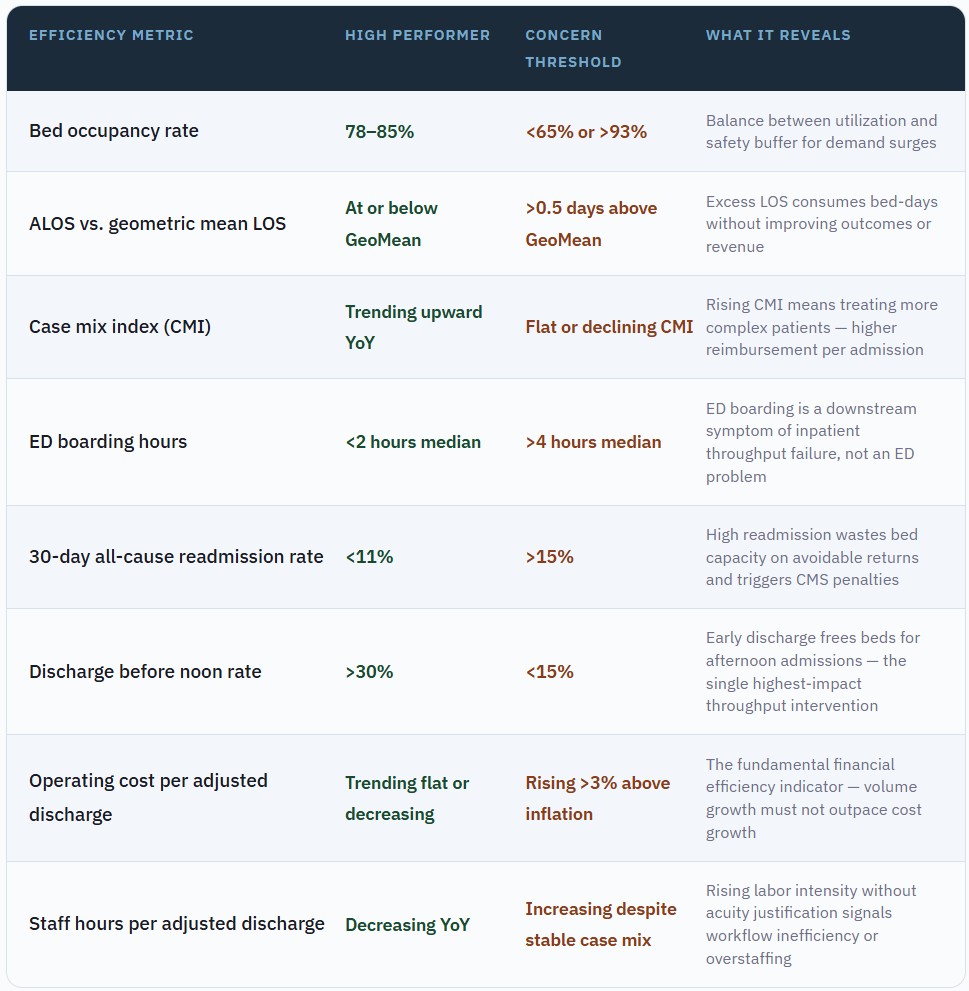
Hospital efficiency is measured — when it is measured rigorously — through a family of interconnected metrics that track how well the organization converts its physical, human, and financial resources into clinical outcomes and financial return. The table below presents the metrics I use in operational assessments, with the benchmarks that distinguish high-efficiency from average-efficiency hospitals.
When efficiency metrics are optimized in isolation, they destroy each other
A hospital that aggressively reduces ALOS without improving discharge planning will increase readmissions. A hospital that maximizes bed occupancy without managing surge capacity will experience periodic throughput crises that compromise both safety and patient experience. A hospital that cuts staff hours per discharge without redesigning workflows will push clinical staff to unsafe ratios. Efficiency metrics must be managed as a system, with leading and lagging indicators balanced against each other and against clinical outcome measures. The goal is not the metric — the goal is the operational condition the metric is designed to reflect.
The four modes of hospital growth — and when each is appropriate
Hospital growth is not a single strategy. It is a family of strategic choices, each appropriate under different market conditions, financial positions, and operational maturity levels. Understanding which mode of growth applies to your hospital’s current situation is the most important strategic judgment a leadership team makes.
The most capital-efficient and operationally lowest-risk form of growth. A hospital operating at 72% occupancy with an ALOS one day above its geometric mean can grow admissions significantly without adding a single bed — by reducing ALOS through better discharge planning, improving throughput processes that clear ED boarding, and expanding elective case volume into underutilized surgical capacity. Hospitals that pursue organic growth first consistently outperform those that move directly to capital expansion, because they build the operational muscle to use what they already have before acquiring more. This mode is appropriate for any hospital with occupancy below 85% and ALOS above geometric mean.
Rather than growing across the board, strategic service line growth concentrates investment in the clinical areas where the hospital has — or can build — a defensible competitive position: cardiovascular, oncology, orthopedics, neuroscience, behavioral health, maternal health. This mode requires service line-level P&L visibility, market share data, and a clear understanding of the clinical workforce available to support expansion. It often involves adding specialized beds (e.g., a cardiac step-down unit, a cancer center infusion suite) rather than general medical-surgical capacity. The key discipline is sequencing: clinical program development and physician recruitment must precede physical capacity expansion, not follow it.
Capital expansion — new beds, new facilities, new campuses — is the growth mode that generates the most board attention and the most planning errors. It is appropriate when and only when three conditions are simultaneously met: demonstrated demand that cannot be served by throughput optimization, a financial structure that supports the debt service of the capital investment, and an operational capability to staff and run the expanded capacity. The order matters critically. Hospitals that build first and then discover they cannot recruit the nursing staff to open the new beds, or that the demand projections were based on pre-pandemic referral patterns that no longer hold, represent the costly failure mode of this growth strategy.
The fourth mode of growth is the newest and the most strategically underutilized in most health systems: expanding care delivery capacity through Hospital-at-Home programs, telehealth service lines, outpatient procedure center development, and remote patient monitoring — effectively growing the hospital’s patient management capacity without growing its inpatient bed count in proportion. This mode is not a replacement for physical capacity when physical capacity is genuinely needed. But it can defer capital expansion by two to five years for hospitals that are operationally ready, and it generates a patient relationship model that is more portable, more accessible, and more aligned with how patients increasingly prefer to receive care.
How growth, beds, and efficiency interact — the dynamics no planning model captures
The relationship between these three concepts is not linear and it is not static. Understanding the dynamics — the feedback loops, the lag effects, the failure modes — is what separates strategic hospital planning from sophisticated spreadsheet exercises.
You cannot sustainably grow into an inefficient operation
A hospital with a 90% readmission prevention gap, an ALOS two days above geometric mean, and a bed occupancy that swings between 60% and 95% in the same month does not need more beds. It needs a fundamentally better throughput system. Adding capacity to an inefficient operation magnifies the inefficiency — more beds means more complexity, more staff, more surface area for the existing operational problems to express themselves. The efficiency work must precede or run concurrent with the growth investment, not follow it. This sequencing principle is violated in nearly every hospital expansion project I have observed that subsequently underperforms.
Bed pressure is almost never a bed problem
When a hospital reports that it is “out of beds” — patients boarding in the ED, elective procedures being cancelled, ambulance diversions being called — the instinctive response is to plan for more beds. The correct diagnostic response is to ask what is keeping the existing beds occupied longer than clinical necessity requires. The answer is almost always one of three things: discharge delays caused by inadequate social work capacity and post-acute placement bottlenecks; length of stay variation driven by inconsistent physician practice patterns; or a mismatch between where patients are being admitted and where the appropriate nursing expertise sits. Fix those three things, and bed pressure resolves without construction.
Growth temporarily degrades efficiency before it improves it
Every hospital expansion project — new service line, new beds, new campus — goes through an efficiency trough before it reaches operational maturity. New beds require new staff who are less experienced. New service lines require new workflows that have not been optimized. New volumes require new supply chain and support capacity that takes time to calibrate. Leadership teams that do not anticipate this trough — and that measure growth success at 12 months using the same efficiency benchmarks as the mature operation — will consistently conclude that the expansion was a mistake. The performance expectation curve for new capacity must account for a 12-to-24-month ramp period before comparing against steady-state benchmarks.
What a high-performing hospital does with growth, beds, and efficiency together
The hospitals that manage this triad with the greatest long-term effectiveness share a common operating logic. It is not a formula — it is a discipline.
- They measure demand, not just census. High performers distinguish between observed demand (patients who actually arrived) and true demand (patients who arrived plus patients who were diverted, who left without being seen, or who sought care elsewhere because the hospital’s access was too constrained). The gap between observed and true demand is the growth opportunity that bed expansion should be designed to capture — but almost never is.
- They set an efficiency floor before a capacity ceiling. Before any capital expansion project is approved, high-performing hospitals require a documented analysis of throughput optimization potential: how much additional volume could the existing capacity absorb if ALOS were reduced, discharge timing improved, and patient placement optimized? This analysis becomes the operational baseline against which capital expansion is justified — or deferred.
- They manage beds by type, not by total count. Occupancy by bed type is tracked daily. The hospital that is 92% occupied in ICU and 61% occupied in medical-surgical is not facing a global bed shortage — it is facing a step-down capacity bottleneck that is preventing ICU patients from downgrading and blocking new ICU admissions. The solution is a targeted step-down expansion, not a general bed addition.
- They plan workforce and capacity together, not sequentially. The capital plan and the workforce plan are developed simultaneously, with the workforce constraint treated as a hard limit on the capacity expansion scope. A hospital that plans 80 new beds but can only recruit nursing staff for 50 should plan 50 beds — not 80 beds that will sit unstaffed and generate carrying cost without revenue.
- They track growth quality, not just growth volume. Net revenue per adjusted discharge, readmission rate by service line, contribution margin by payer type, and patient experience scores are all growth quality metrics. A hospital that grew admissions by 8% while its case mix declined, its readmission rate rose, and its nursing turnover increased did not grow — it diluted its operational base.
- They build for the community they are serving, not the facility they imagine. The best hospital capacity plans begin with an honest analysis of the population’s health profile, its social determinants, its disease burden trajectory, and its access to alternatives — not with a competitor analysis that rationalizes adding beds because the hospital across town has more of them. Beds built to match a competitor are often beds built for a population the hospital does not fully understand.
The governing principle: beds are a means, not a measure of success
The hospitals that navigate growth most successfully in the decade ahead will be the ones that have freed themselves from the instinct to equate hospital size with hospital strength. The bed count is a proxy — a convenient, visible, easily compared proxy — for the deeper question of whether a hospital can reliably deliver high-quality care to the patients who need it, when they need it, in the most appropriate setting, at a cost the system can sustain.
A 150-bed community hospital with 84% occupancy, an ALOS consistently at geometric mean, a 30-day readmission rate of 10%, and a clinical documentation program that accurately captures the acuity of its patients is, by every meaningful operational measure, performing better than a 400-bed regional medical center with 68% occupancy, an ALOS 1.8 days above geometric mean, and an ED boarding problem that generates weekly operational crises.
“Hospital growth is not about building more. It is about becoming more — more accessible, more effective, more responsive to the community’s actual health needs. Beds enable that mission when they are planned intelligently. When they are not, they consume capital, staff, and attention without advancing it.”
Growth, beds, and efficiency are not three separate strategic priorities to be balanced against each other in a planning document. They are three dimensions of a single operating reality — and the health systems that understand them as such, and plan accordingly, are the ones that will be serving their communities well in 2030 and beyond.