

Hospital Strategy & Digital Transformation
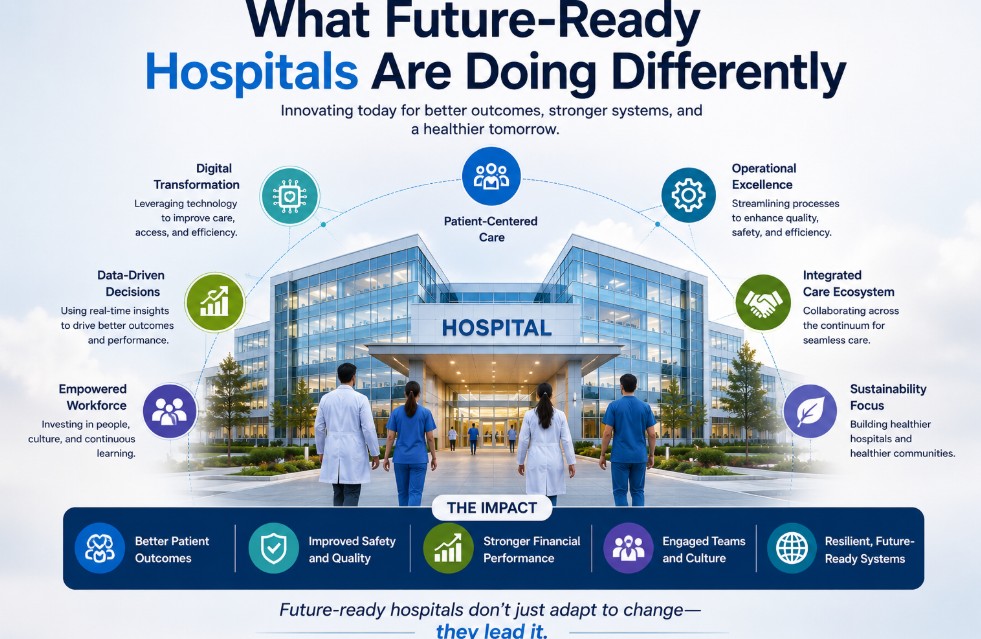
In thirteen years of leading projects across health systems, pharmaceutical organizations, and payer-provider collaborations, I have watched two categories of hospital emerge with increasing clarity. The first category is working hard — upgrading EHRs, installing dashboards, attending digital health summits — but fundamentally operating on the same logic they used in 2010. The second category has made a different kind of decision: not just to adopt new technology, but to rewire how decisions get made, how data moves, how staff are deployed, and how patients experience care between appointments.
This blog is about that second category. What they are doing. Why it is working. And what the first category needs to understand before the gap becomes permanent.
First: what “future-ready” is not
Future-readiness is not a technology checklist. Hospitals have been burned repeatedly by the assumption that purchasing a sophisticated platform automatically transforms the organization underneath it. The enterprise EHR that took three years and $150 million to implement and delivered six months of workflow chaos. The AI-powered triage tool that no clinician trusted because no clinician was involved in designing it. The patient portal that 4% of patients actually used.
Future-readiness is not a capital project. It is not a department. It is not a buzzword strategy deck. And it is emphatically not something that happens to a hospital — it is something a hospital decides, funds, and executes as a core operational capability.
Many hospitals confuse technology adoption with operational transformation. Adoption is purchasing and installing a capability. Transformation is redesigning the human processes, governance structures, and organizational incentives around that capability until it produces a different outcome than what existed before. Most hospitals do the first. Very few complete the second. Future-ready hospitals have closed this gap deliberately.
The seven operational shifts that define future-ready hospitals
What follows is not a ranked list of technologies. It is a map of operational decisions — the places where future-ready hospitals have made a different choice than their peers, and where that choice is now compounding into a measurable performance advantage.
Strategy
The traditional hospital sees a patient when the patient arrives. Everything about that encounter — vitals, orders, notes, discharge instructions — is captured, coded, and filed. The next time that patient appears, the cycle restarts. Future-ready hospitals have broken this episodic frame. They are building and maintaining a longitudinal health record that integrates across the encounter: remote monitoring data between admissions, pharmacy adherence signals, social determinants flags from community health partners, and behavioral health touchpoints that often predict physical health deterioration weeks in advance. The clinical decision-making that happens at the bedside is informed by what happened at home in the preceding 30 days — not just the last set of labs drawn in the ED. This requires interoperability infrastructure, data governance, and a clinical culture that trusts data sources outside the hospital’s own walls. That cultural shift is harder than the technical one.
Operations
Every hospital manages bed capacity. Future-ready hospitals predict it — with enough lead time to actually act. Using historical admission patterns, real-time ED census, surgical schedule data, and machine learning models trained on their own population, these organizations generate 48-to-72-hour capacity forecasts that drive proactive staffing decisions, elective procedure scheduling, and discharge planning acceleration. The difference is not just operational efficiency — it is clinical. When a hospital knows that Thursday will bring a surge of post-surgical patients requiring step-down beds, it can open those beds on Wednesday rather than scrambling at midnight. Predictive capacity management has been consistently associated with lower rates of boarding in the ED, better patient experience scores, and — critically — lower nurse burnout, because staff are not perpetually in a reactive crisis mode that erodes both safety and retention.
Technology
In most hospitals, interoperability is delegated entirely to the IT department and measured by whether the EHR can receive a CCD document from another system. Future-ready hospitals have elevated interoperability to a board-level strategic priority — because they understand that a hospital’s ability to receive, contextualize, and act on data from outside its walls is now a direct determinant of clinical quality and financial performance. These organizations have invested in FHIR R4 API infrastructure, established bidirectional data-sharing agreements with post-acute partners and primary care networks, and built internal data governance functions that own the quality of incoming data — not just the pipes that carry it. They also understand that interoperability is a relationship, not just a technical standard: the human agreements that allow data to flow matter as much as the API specifications.
Operations
Traditional hospital care teams are organized around physical units — the ICU team, the med-surg team, the oncology floor team. The patient moves through the hospital’s geography, and the team changes with each transition. Future-ready hospitals are experimenting with — and in some cases fully deploying — longitudinal care team models in which a consistent team follows the patient across settings: from preadmission through the inpatient stay, into post-discharge monitoring, and back to the outpatient primary care context. The care coordinator who calls the patient on day three post-discharge is the same person who was present at the discharge planning meeting and who will flag an escalation if the remote monitoring device shows a concerning trend on day seven. This continuity is not an operational luxury — it is a structural intervention against the fragmentation that drives unnecessary readmissions and preventable deterioration.
Technology
The difference between a hospital that has “an AI initiative” and a future-ready hospital is not the sophistication of the algorithm — it is where the output of that algorithm actually lands. Future-ready hospitals have embedded AI-generated recommendations directly into the clinical workflow: sepsis early warning scores surfaced in the nurse’s existing patient monitoring view, not in a separate application requiring a separate login; deterioration alerts routed through the same escalation communication tool the team already uses; medication reconciliation discrepancy flags appearing in the pharmacist’s verification queue with the same visual language as other alerts. The design principle is that AI should reduce the cognitive burden on the clinician — not add a new dashboard they have to remember to check. Organizations that have achieved this integration report measurably higher clinician adoption and, consequently, measurably better outcomes from the same underlying algorithms.
Culture
This is the shift that surprises people most when I describe it. Future-ready hospitals are not just investing in technology — they are investing in the human conditions that determine whether technology is used well. The research on this is now unambiguous: units with high psychological safety — where staff feel they can raise concerns, flag errors, and question clinical decisions without fear of retribution — have dramatically lower rates of preventable adverse events, faster escalation of deteriorating patients, and higher rates of near-miss reporting that drives system improvement. Future-ready hospitals have operationalized this through structured speaking-up frameworks, no-blame incident review processes, and leadership behaviors that model vulnerability. The Chief Nursing Officer who walks into a safety huddle and describes a near-miss from their own experience is doing patient safety work. This is not soft culture management — it is hard-edged clinical risk reduction.
Patient Experience
Hospital-at-Home is no longer a pandemic-era experiment. Future-ready hospitals are operationalizing it as a permanent service line — delivering acute-level care to appropriately selected patients in their own homes, with continuous remote monitoring, twice-daily in-person or virtual clinical visits, and clear escalation pathways back to the physical facility. The evidence on outcomes is compelling: comparable or better clinical results for many DRG categories, dramatically higher patient satisfaction, lower infection risk, and significant cost reduction. But Hospital-at-Home is not a technology program — it is a care model that requires patient selection criteria, clinical protocols, monitoring workflows, logistics infrastructure for supply delivery, and a staffing model that is fundamentally different from anything the traditional hospital has operated before. The hospitals that are scaling this successfully are the ones that designed the operational model first and then selected the technology to support it — not the reverse.
The operating model contrast: then versus now
The table below captures the specific operational decision points where future-ready hospitals diverge from the traditional model. Each row represents a real organizational choice — not a technology feature.
| Dimension | Traditional hospital logic | Future-ready hospital logic |
|---|---|---|
| Data model | Encounter-centric; data lives in departmental silos tied to the visit | Patient-centric; longitudinal record aggregates across settings and time |
| Capacity management | Reactive: respond to census pressure as it arrives | Predictive: 48–72 hour forecasts drive proactive staffing and scheduling decisions |
| AI integration | Separate dashboards; clinicians must remember to check | Embedded in existing workflow; output appears in the tool the clinician already uses |
| Care team structure | Unit-based; patient transitions teams as they move through the building | Longitudinal; consistent team follows patient across care settings |
| Patient boundary | Hospital walls define the care relationship; discharge ends it | Monitoring and engagement extend into the home; discharge begins a new phase |
| Interoperability | IT project; measured by connectivity between owned systems | Strategic capability; measured by quality and actionability of data from external partners |
| Safety culture | Incident-focused; safety is measured by events that occurred | Near-miss focused; psychological safety enables proactive risk identification before harm occurs |
| Workforce model | Staffing optimized for average census; surges managed with agency staff | Flexible staffing pool with predictive deployment; agency use is an exception, not a budget line |
“The future-ready hospital is not defined by the sophistication of its technology stack. It is defined by the quality of the decisions it makes with the information it has — and by how quickly those decisions reach the people who can act on them.”
Where is your hospital on the maturity curve?
Future-readiness is not a binary state. It is a progression, and most hospitals sit somewhere in the middle — having made meaningful progress on some dimensions while remaining deeply traditional on others. The maturity model below describes the four stages I observe across health systems, and the characteristics that define each.
Paper replaced by EHR. Processes are electronic but otherwise unchanged. Data is captured, rarely analyzed. Decisions are clinical intuition plus historical habit.
Systems communicate. Dashboards exist. Some departments use analytics for operational decisions. AI pilots are underway. Integration is partial and fragile.
Predictive tools are embedded in clinical workflows. Interoperability spans the care continuum. The care model extends beyond hospital walls. Governance structures exist to sustain this.
The hospital learns continuously. Clinical protocols update on evidence cycles measured in weeks. The workforce is structured around patient outcomes, not departmental ownership. Technology is a capability, not a project.
Most hospitals reading this are at Stage 2, with pockets of Stage 3 capability in specific departments or service lines. The critical insight is that the gap between Stage 2 and Stage 3 is not primarily a technology gap — it is a governance and culture gap. You can close the technology gap in 18 months with sufficient capital. The governance and culture work takes three to five years and requires leadership continuity that many health systems struggle to maintain.
The five foundations every future-ready hospital has built first
A named body accountable for data quality, access policy, and the standards that govern how external data is validated before clinical use.
A CMIO or equivalent who bridges clinical credibility and technical fluency — and who has budget authority, not just advisory influence.
A structured mechanism for clinicians and support staff to participate in workflow redesign before any system goes live — not after adoption fails.
The ability to measure the clinical and operational impact of specific workflow changes within 90 days — not to wait for annual quality reports.
Contracts with technology partners that include outcome-linked performance metrics, exit provisions, and data portability rights — not just uptime SLAs.
What gets in the way — and why it is not what leaders usually think
When I ask hospital leaders what is blocking their transformation journey, the most common answers are budget constraints, legacy technology debt, and regulatory burden. These are real. But they are not the primary blockers I observe in organizations that are genuinely struggling to move forward.
What the next five years will demand — and why starting now is the only viable option
The pressures converging on hospitals over the next five years are well-documented but underappreciated in their cumulative force: an aging population with multi-morbid chronic conditions that existing care models were not designed to manage at scale; a nursing and physician workforce that is structurally insufficient relative to projected demand; payer models shifting relentlessly toward value-based arrangements that reward outcomes over volume; and a patient population that has experienced consumer-grade digital experiences in every sector of their life and is increasingly unwilling to tolerate friction, opacity, and fragmentation in their healthcare.
Future-ready hospitals are not building for a hypothetical future. They are building for a present that arrived earlier than most planning documents anticipated, and accelerating toward a 2030 that will be defined by capabilities that take three to seven years to build from scratch.
“A hospital that begins its digital transformation journey in 2026 will be operational in 2029. A hospital that has been building since 2022 will be adaptive by 2027. That gap — two years of compounding operational capability — is likely to be the most consequential competitive differential in the next decade of healthcare.”
The hospitals in the second category did not start because they had perfect conditions. They started because they understood that transformation has a minimum time cost that no amount of capital can compress below a certain threshold. The human learning, the clinical trust-building, the governance maturation — these take time. The only way to have them when you need them is to have started building them before you needed them.
Future-ready hospitals are not exceptional organizations run by exceptional people. They are organizations that made a different set of commitments — to a different operating logic, to a different relationship with data, and to a different definition of where the hospital’s responsibility for a patient begins and ends. Those commitments are available to every health system, regardless of size, geography, or current technology state.
The question is not whether the future is coming. The question is whether your hospital is building toward it or waiting for it.
Hey there, readers! Welcome to my little corner of the internet. I ain’t just your average blogger — I’m a seasoned project manager with a knack for diving deep into research and unraveling the mysteries of project management. But that’s not all there is to me! With a background in Healthcare, IT and Pharmaceuticals for Project management, hospital management and a passion for travel, hiking, and trekking, I’m all about blending the professional with the adventurous. So, join me on this voyage where we’ll explore the ins and outs of strategy, project management and share tales from the management, travels, and maybe even swap tips along the way.
Feel free to visit my site to know more about my researched output in the form of blogs: http://www.virsafeed.com/
Would you like to connect with me? Please drop me an email at virsafeed.com@gmail.com