


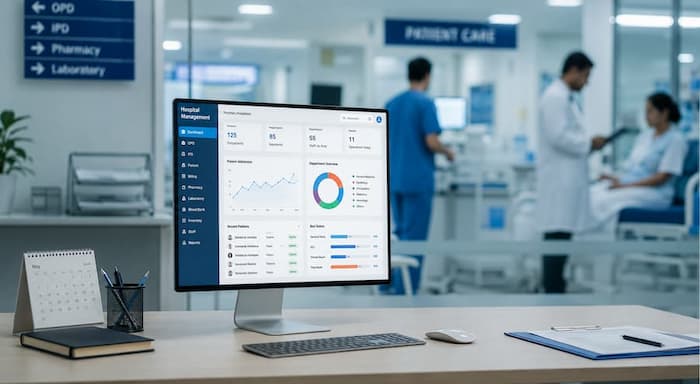
Where healthcare operations meet digital innovation.
Healthcare today is experiencing one of its most transformative shifts in history. Hospitals are moving away from paper-based records, disconnected systems, and manual processes toward intelligent digital ecosystems.
At the center of this transformation sits the Hospital Management System (HMS).
If you are a healthcare professional, product owner, business analyst, project manager, implementation specialist, or someone entering healthcare technology, this guide is designed to become your starting point.
This article explains what an HMS is, why hospitals need it, how implementation works, common challenges, and lessons learned from leading such initiatives in regulated healthcare environments.
What is a Hospital Management System (HMS)?
A Hospital Management System is an integrated software platform designed to manage and automate hospital workflows, clinical operations, patient records, financial processes, and administrative functions through a centralized digital ecosystem.
Instead of multiple disconnected applications, HMS creates a unified system where information flows seamlessly between departments.
Think of HMS as the operating system of a hospital.
Just as the human body relies on connected organs, hospitals rely on connected workflows.
Without integration:
- Data duplication increases
- Operational delays occur
- Human errors become common
- Reporting becomes difficult
- Patient experience suffers
An HMS addresses these challenges.
Why Healthcare Organizations Need HMS in 2026 and Beyond
Healthcare delivery is becoming increasingly complex.
Hospitals today manage:
- Thousands of patient records
- Multiple specialty departments
- Compliance requirements
- Billing workflows
- Inventory management
- Clinical documentation
- Diagnostic integrations
- Data security requirements
Manual systems can no longer keep pace.
Modern hospitals need:
Faster patient onboarding
Digital registration reduces wait times and improves efficiency.
Better patient experience
Integrated scheduling and communication simplify care journeys.
Data-driven decision making
Leadership teams require real-time operational dashboards.
Regulatory compliance
Healthcare organizations must maintain traceability and audit readiness.
Improved resource utilization
Hospitals need visibility into beds, staff, inventory, and infrastructure.
Core Modules of a Hospital Management System
A successful HMS is not one feature.
It is an ecosystem of connected modules.
1. Patient Registration Management
Captures:
- Patient demographics
- Contact information
- Medical history
- Insurance details
- Unique identifiers
This becomes the foundation for all downstream workflows.
2. Appointment and Scheduling System
Enables:
- Doctor scheduling
- Resource allocation
- Queue management
- Automated reminders
This directly impacts patient satisfaction.
3. Electronic Medical Records (EMR)
Digital medical records centralize:
- Diagnoses
- Prescriptions
- Progress notes
- Laboratory reports
- Clinical documentation
EMR implementation significantly reduces documentation errors.
4. Laboratory Information Integration
Allows:
- Test ordering
- Sample tracking
- Report generation
- Integration with diagnostic systems
5. Pharmacy Management
Helps hospitals manage:
- Medication inventory
- Prescription tracking
- Dispensing workflows
- Expiry monitoring
6. Billing and Revenue Cycle Management
Supports:
- Invoicing
- Claims processing
- Insurance workflows
- Financial reporting
7. Analytics and Reporting
Leadership teams need answers such as:
- Daily patient load
- Department utilization
- Revenue trends
- Operational bottlenecks
Analytics transforms data into decisions.
My Role: Leading Product Development and Implementation
Beyond technology implementation, healthcare solutions require orchestration between people, processes, compliance teams, and business objectives.
As the Senior Project Manager handling this solution, my responsibilities included:
Requirement Discovery
Conducting stakeholder workshops involving:
- Physicians
- Operations teams
- Finance departments
- IT teams
- Quality stakeholders
- Leadership teams
Translating Requirements into Product Features
One major challenge in healthcare technology is that users describe operational pain points rather than technical solutions.
The role of product leadership becomes translating:
“We spend too much time finding patient information”
into
“Develop centralized patient record access with role-based permissions.”
GxP and Validation Considerations
Healthcare systems operating in regulated environments require more than functionality.
They require:
- Audit trails
- Data integrity controls
- User access management
- Requirement traceability
- Validation documentation
- Change management
Technology implementation in GxP environments is not only deployment.
It is controlled transformation.
Common Challenges During HMS Implementation
For beginners entering healthcare projects, implementation is rarely only a technical activity.
Major challenges include:
Resistance to change
Healthcare staff often operate under high workload conditions.
New systems introduce learning curves.
Complex workflows
No two hospitals operate identically.
Customization becomes necessary.
Legacy system integration
Many organizations still rely on disconnected platforms.
Integrating historical systems becomes a significant challenge.
Regulatory expectations
Healthcare systems require strict governance and validation.
Lessons for New Project Managers Entering Healthcare Technology
If you are beginning your journey in healthcare project management, remember:
Technology alone does not solve healthcare problems.
Processes matter.
People matter.
Adoption matters.
Understanding users matters.
Before implementation:
Ask:
- Why does this process exist?
- Who uses it?
- What problem does it solve?
- What happens if it fails?
These questions often reveal insights more valuable than technical specifications.
The Future of Hospital Management Systems
The next generation of HMS platforms is evolving rapidly through:
- Artificial Intelligence in healthcare
- Predictive analytics
- Clinical decision support
- IoT medical device integration
- Cloud-native healthcare platforms
- Interoperability standards
- Real-time operational intelligence
Healthcare technology is moving from record management toward intelligent care ecosystems.
Final Thoughts
Hospital Management Systems are not simply software products.
They are transformation initiatives.
Leading such programs taught me that success depends less on technology and more on aligning strategy, people, compliance, and execution.
For professionals entering healthcare technology or healthcare project management, understanding HMS provides one of the strongest foundations for understanding digital healthcare transformation.
The future of healthcare belongs to connected systems, informed decisions, and patient-centered innovation.
And every successful implementation starts with understanding the journey before writing the first requirement.
Know the Author
Hey there, readers! Welcome to my little corner of the internet. I ain’t just your average blogger — I’m a seasoned project manager with a knack for diving deep into research and unraveling the mysteries of project management. But that’s not all there is to me! With a background in Healthcare, IT and Pharmaceuticals for Project management, hospital management and a passion for travel, hiking, and trekking, I’m all about blending the professional with the adventurous. So, join me on this voyage where we’ll explore the ins and outs of strategy, project management and share tales from the management, travels, and maybe even swap tips along the way.
Feel free to visit my site to know more about my researched output in the form of blogs: http://www.virsafeed.com/
Would you like to connect with me? Please drop me an email at virsafeed.com@gmail.com