

One Participant. One Identity. One Source of Truth.
Clinical trials depend on trust, accuracy, and clear identity verification. When a participant arrives at a site, the research team must be certain that the right person is being seen, the right record is being updated, and the right safety and dosing decisions are being made. In many situations, paper documents, verbal confirmation, or basic ID checks are not enough. That is where biometric identification becomes valuable.
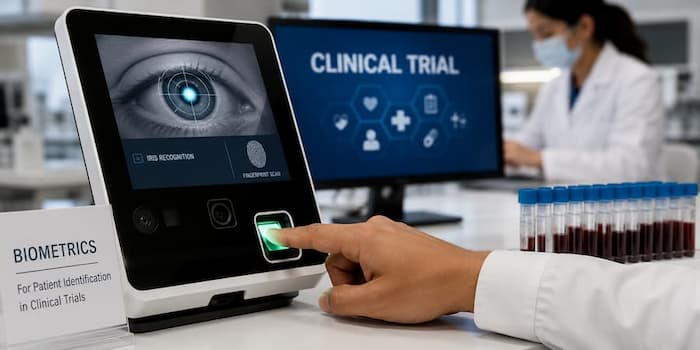
Biometrics in clinical trials refers to the use of unique human characteristics such as iris patterns or fingerprints to verify a participant’s identity. These methods are especially useful when physical identification fails, when records are unclear, or when trials need a higher level of confidence in subject matching. For organizations working in regulated environments, biometrics can strengthen traceability, reduce identity errors, and support better trial control.
Why identity verification matters
Every clinical trial depends on correct subject identification. If the wrong participant is linked to the wrong visit, sample, dose, or assessment, the trial data can become unreliable. The problem may seem small at first, but in research settings even one mismatch can affect safety decisions, endpoint accuracy, and protocol compliance.
Traditional methods of identification are not always strong enough. A participant may forget documents, carry inconsistent paperwork, share a similar name with another subject, or arrive at a site where staff are unfamiliar with them. In decentralized or multi-site trials, these issues become even more likely. Biometrics help solve this problem by creating a more reliable link between the person and the study record.
What biometric identification means
Biometric identification uses physical traits that are unique to a person. In clinical research, two of the most useful methods are fingerprint recognition and iris recognition. These methods do not depend on memory, printed cards, or manual interpretation. Instead, they compare the live biometric input with the enrolled reference pattern already stored in the system.
That makes biometrics a strong identity control. A properly designed biometric system can help sites verify participants quickly and with much greater confidence than manual checks alone. It also reduces the chance of duplicate enrollment, impersonation, or mistaken identity.
How iris recognition works
Iris recognition uses the detailed pattern found in the colored part of the eye. The iris is highly distinctive, even among people with similar features. During enrollment, the system captures an image of the iris and converts it into a digital template. Later, when the participant returns for a visit, the system captures the iris again and compares it to the stored template.
The reason iris recognition is so powerful is that the iris pattern is extremely complex and stable. That gives it a very high level of accuracy when implemented properly. It is also contactless, which makes it convenient in clinical environments where hygiene, speed, and user comfort matter.
In a trial setting, iris recognition can be used to confirm that a participant is the same person who was enrolled earlier. This is especially useful when multiple visits are required over a long study period and when the risk of identity confusion must be minimized.
How fingerprint recognition works
Fingerprint verification is another widely used biometric method. It works by scanning the unique ridge pattern on a person’s fingertip and comparing it with the fingerprint captured at enrollment. Because fingerprint scanners are familiar and relatively easy to use, they are often a practical choice for clinical sites.
Fingerprint biometrics are useful when organizations need a fast and reliable way to confirm identity. They can be deployed at scale, are generally easy for users to understand, and fit well into routine site workflows. In clinical trials, they can support visit authentication, sample collection, dosing verification, and participant check-in.
Why biometrics are useful in clinical trials
Biometric systems bring several important advantages to clinical research. First, they improve identity verification. Second, they reduce the risk of wrong-subject errors. Third, they support stronger operational control across study visits. Fourth, they help sites maintain better traceability of participant activity.
In practical terms, this means the research team can be more confident that the person being examined, dosed, or followed up is truly the enrolled subject. That confidence matters for safety, data quality, and protocol integrity. It also helps reduce the time spent on manual identity checks and repeated questioning at each visit.
Biometrics can be especially valuable in studies with repeated visits, long follow-up periods, or sites that handle large numbers of participants. They can also be useful in settings where participants may not always carry reliable identification documents.
Where biometrics add the most value
Biometric verification is particularly useful in trials where identity uncertainty creates operational risk. That includes studies with high visit frequency, decentralized trial components, multiple study sites, or complex subject follow-up.
It is also useful in environments where manual identity checks are difficult. For example, a participant may come from a remote location, may have limited documentation, or may be participating in a long-term study where staff turnover makes personal recognition less dependable. In these cases, biometric verification offers a more stable and objective way to confirm identity.
Biometrics can also help when a trial must maintain a strong audit trail. Because the identity match can be recorded electronically, the site has an additional layer of documentation that supports review and accountability.
The role of biometrics in compliance
In regulated research, identity verification is not only an operational issue. It is also a compliance issue. Trial teams must be able to show that the correct subject was linked to the correct record and that sensitive personal data was managed responsibly.
That means biometric systems must be handled carefully. Consent, privacy, data protection, retention, and access control all matter. The system should be designed so that biometric data is stored securely and used only for its intended purpose. Good governance is essential because biometric information is highly sensitive.
From a project management perspective, implementing biometrics requires clear requirements, stakeholder alignment, validation planning, and user training. The technology may be powerful, but it must also fit the study process and the regulatory environment.
Important limitations to understand
It is tempting to say that iris recognition or fingerprint scanning always works perfectly. In reality, no biometric technology is flawless. Accuracy depends on enrollment quality, scan quality, device performance, environmental conditions, and user behavior.
For example, if a fingerprint is damaged or a scan is poorly captured, the system may need a repeat attempt. If the iris image is obscured or the participant is not positioned correctly, matching can be affected. These are operational issues, not failures of the concept itself, but they show why implementation matters.
A strong biometric program is not just about the algorithm. It is about good enrollment, proper workflow design, trained staff, reliable hardware, and secure handling of data. When those parts work together, biometrics become far more effective.
What beginners should know
If you are new to this topic, the simplest way to understand biometrics in clinical trials is this: the system uses a person’s body to confirm their identity instead of relying only on paperwork or memory. The participant is enrolled once, their biometric pattern is stored securely, and future visits use that same pattern to confirm the match.
That means the site can verify the right person quickly, consistently, and with more confidence. This is especially helpful in trials where identity accuracy affects dosing, safety monitoring, and data quality.
A beginner can think of biometrics as an additional identity layer that helps protect the study from avoidable mistakes. It does not replace clinical judgment, but it strengthens the process around it.
Final thoughts
Biometrics bring a higher level of confidence to clinical trial identity verification. Iris recognition and fingerprint scanning help sites confirm the right participant, reduce identity-related errors, and strengthen traceability across the study lifecycle. In environments where documentation alone may fail, biometrics provide a practical and dependable backup.
For clinical research teams, the biggest value lies in better control. For participants, it can make the process faster and more secure. For sponsors and sites, it supports data integrity and operational confidence. When implemented thoughtfully, biometrics can become an important part of modern trial execution.
Know the Author
Hey there, readers! Welcome to my little corner of the internet. I ain’t just your average blogger — I’m a seasoned project manager with a knack for diving deep into research and unraveling the mysteries of project management. But that’s not all there is to me! With a background in Healthcare, IT and Pharmaceuticals for Project management, hospital management and a passion for travel, hiking, and trekking, I’m all about blending the professional with the adventurous. So, join me on this voyage where we’ll explore the ins and outs of strategy, project management and share tales from the management, travels, and maybe even swap tips along the way.
Feel free to visit my site to know more about my researched output in the form of blogs: http://www.virsafeed.com/
Would you like to connect with me? Please drop me an email at virsafeed.com@gmail.com