


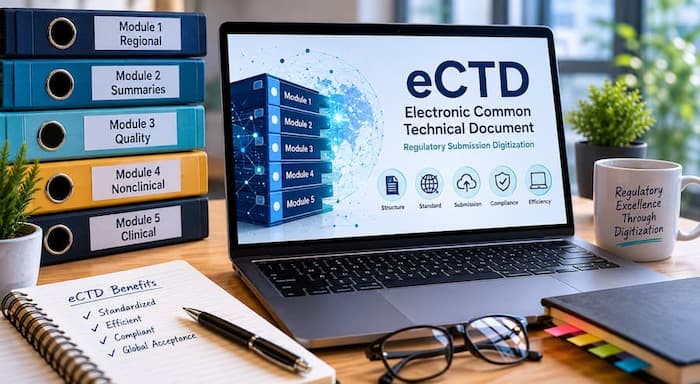
Accelerating approvals through regulatory excellence.
The pharmaceutical industry does not simply create medicines.
It creates enormous volumes of scientific, clinical, manufacturing, and regulatory documentation.
Before a drug reaches patients, organizations must prepare and submit structured information to global health authorities.
Historically, this process involved paper submissions, manual assembly, and complex documentation management.
As pharmaceutical products expanded globally, these approaches became difficult to sustain.
This challenge led to the emergence of the Electronic Common Technical Document (eCTD).
If you are beginning your journey in pharmaceuticals, regulatory operations, healthcare technology, or digital transformation programs, understanding eCTD provides foundational knowledge for navigating modern regulatory ecosystems.
This guide explains what eCTD is, why it matters, implementation considerations, and lessons learned while leading these initiatives.
What is an Electronic Common Technical Document (eCTD)?
An Electronic Common Technical Document is an internationally standardized electronic submission format used by pharmaceutical organizations for regulatory submissions.
It provides a structured framework for submitting information to health authorities.
eCTD helps organize and manage:
- Administrative information
- Product quality documentation
- Nonclinical studies
- Clinical study information
- Regulatory lifecycle activities
Rather than submitting disconnected files or paper documentation, organizations create standardized electronic submissions.
Think of eCTD as the digital language of regulatory submissions.
Why eCTD Matters in Modern Pharmaceuticals
Global pharmaceutical organizations submit information to multiple regulatory agencies.
Without standardization, organizations face:
- Duplicate efforts
- Submission inconsistencies
- Document tracking challenges
- Higher operational burden
- Increased compliance risk
eCTD introduced structure and consistency.
Benefits include:
Improved submission efficiency
Reduces manual assembly activities.
Better document organization
Supports structured and searchable content.
Regulatory standardization
Aligns with internationally accepted frameworks.
Enhanced lifecycle management
Tracks updates and modifications over time.
Improved collaboration
Enables coordinated work across teams.
Understanding the eCTD Structure
One of the most important concepts for beginners is understanding how eCTD content is organized.
The structure commonly includes:
Module 1
Regional administrative information.
May vary based on health authority requirements.
Module 2
High-level summaries and overviews.
Includes:
- Quality summaries
- Clinical summaries
- Nonclinical summaries
Module 3
Quality documentation.
Includes:
- Manufacturing information
- Product specifications
- Stability information
Module 4
Nonclinical study reports.
Includes:
- Pharmacology studies
- Toxicology studies
Module 5
Clinical study documentation.
Includes:
- Clinical reports
- Study results
- Supporting evidence
This modular structure enables standardized submission preparation globally.
Key Features of eCTD Solutions
Modern eCTD platforms support:
Submission compilation
Assembling content into submission-ready structures.
Sequence management
Tracking lifecycle updates over time.
Validation workflows
Checking submission readiness against regulatory requirements.
Metadata management
Supporting structured document classification.
Audit trails
Capturing user activities and changes.
Reporting dashboards
Providing visibility into submissions and timelines.
My Experience: Leading eCTD Product Development and Implementation
Regulatory systems differ from many traditional enterprise applications.
The challenge is balancing operational efficiency with stringent compliance expectations.
As Senior Project Manager, responsibilities included:
Stakeholder Discovery Workshops
Collaborating with:
- Regulatory affairs teams
- Quality stakeholders
- Business users
- Technology teams
- Compliance teams
- Leadership groups
The objective was understanding submission workflows before translating them into digital capabilities.
Translating Regulatory Challenges into Product Requirements
Users often describe process pain points rather than technology needs.
Example:
“Tracking submission versions across teams is difficult.”
This becomes:
“Develop centralized sequence lifecycle visibility with audit and version control capabilities.”
Good systems solve workflow problems—not only technical requirements.
Managing GxP and Validation Requirements
Regulatory platforms operating in pharmaceutical environments require strong controls.
Focus areas included:
- Requirement traceability
- Electronic records controls
- Audit trails
- Role-based access
- Validation documentation
- Change control processes
- Data integrity practices
Technology implementation in regulated environments extends beyond deployment.
Common Challenges During eCTD Implementation
Submission process variability
Organizations often have unique workflows.
User adoption challenges
Transitioning from manual processes requires training and change management.
Metadata complexity
Accurate document classification is essential.
Legacy content migration
Historical submission data requires careful transition planning.
Advice for Beginners Entering Regulatory Technology
Before gathering requirements, focus on understanding:
- How submissions are prepared
- Who owns documentation
- How documents move through review stages
- What compliance risks exist
- How submission timelines are managed
Technology design becomes easier when workflow realities are understood first.
Future of eCTD and Regulatory Systems
Regulatory technology continues evolving through:
- Artificial Intelligence-assisted document classification
- Predictive submission planning
- Cloud-native regulatory ecosystems
- Structured content authoring
- Advanced analytics
- Global interoperability initiatives
- Intelligent workflow automation
The future is moving from document management toward connected regulatory intelligence ecosystems.
Final Thoughts
Electronic Common Technical Document systems are more than submission tools.
They are strategic platforms enabling global regulatory collaboration and compliance.
Leading these initiatives reinforced a recurring lesson:
Successful regulatory technology requires balancing business processes, compliance expectations, operational realities, and user adoption.
Technology organizes information.
Understanding regulatory workflows creates value.
Know the Author
Hey there, readers! Welcome to my little corner of the internet. I ain’t just your average blogger — I’m a seasoned project manager with a knack for diving deep into research and unraveling the mysteries of project management. But that’s not all there is to me! With a background in Healthcare, IT and Pharmaceuticals for Project management, hospital management and a passion for travel, hiking, and trekking, I’m all about blending the professional with the adventurous. So, join me on this voyage where we’ll explore the ins and outs of strategy, project management and share tales from the management, travels, and maybe even swap tips along the way.
Feel free to visit my site to know more about my researched output in the form of blogs: http://www.virsafeed.com/
Would you like to connect with me? Please drop me an email at virsafeed.com@gmail.com