

The Battle of opting between two shoes!
By a Project Manager who also happens to get lost in the mountains – deliberately.
There is a corner in my room that, if you walked in without any context, would tell you a confusing story about the person who lives here.
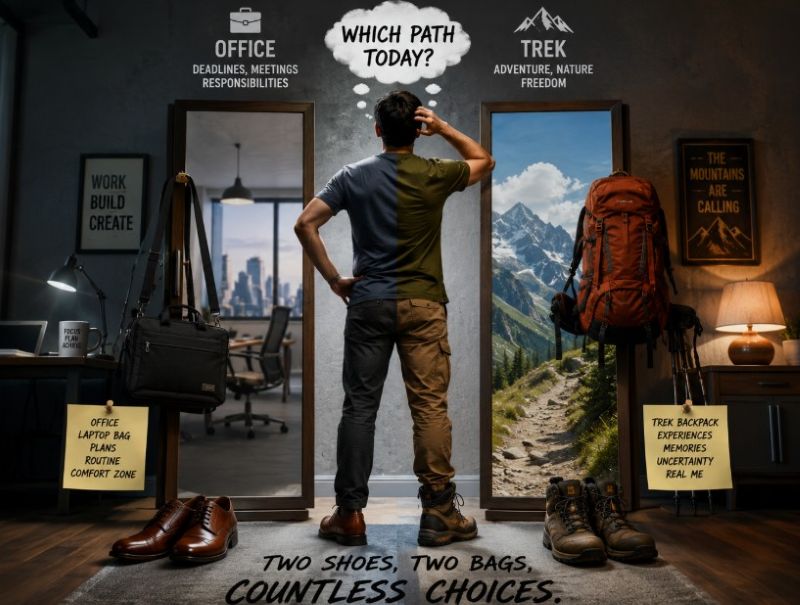
On the left sits a pair of black formal shoes. Polished. Patient. Slightly judgmental, if I’m being honest. The kind of shoes that know their purpose – meetings, presentations, stakeholder calls, and the quiet dignity of clicking across a marble office floor.
On the right sits a pair of trail shoes. Muddy memories still caked on the sole from the last time out. Scuffed at the toe from a loose shale patch on a ridgeline I had no business being on at that altitude. They smell faintly of wet earth and bad decisions that turned into the best stories.
And every single morning – every single one – I stand between them like a judge at a trial I didn’t schedule.
6:48 AM. The Battle Begins.
The alarm goes at six. I lie there for eight minutes convincing myself that’s fine. Then I’m up, kettle on, standing in front of that corner with a half-empty mug and a fully loaded mental debate.
The laptop bag is already sitting by the door. Stacked with a charger, a notebook I’ll write three words in, a project charter I’ve been refining for two weeks, and a granola bar I bought on a Monday with good intentions and haven’t touched since Thursday.
Next to it – and this is where the trouble starts – sits the trek bag. Not fully packed. Never fully unpacked either. There’s a rain jacket stuffed into the top pocket. Two energy bars. A headlamp. A dry-fit layer that’s somehow always slightly damp anyway. And a folded trail map of a route I’ve been meaning to attempt since October.
They sit side by side. Two versions of the same person. Neither one willing to blink first.
The Formal Shoes Know What They Represent
I’ve been in project management and operations long enough to know that structure is not the enemy of freedom. Structure is what makes freedom possible. You plan the route, estimate the risks, align the stakeholders – and then you execute.
The formal shoes represent twelve-plus years of that. Of learning to sit across from a room full of people with competing priorities and finding the thread that ties them together. Of building workflows from nothing, managing healthcare software deliveries under regulatory scrutiny, and learning that the hardest thing in any project is not the technical problem – it’s the human one.
When I put on those shoes in the morning, something shifts slightly. I stand a little straighter. My brain shifts into a mode that’s part analyst, part negotiator, part quiet troubleshooter. The day ahead has a structure. There are deliverables. There are people counting on me to show up clear-headed and ready.
I respect those shoes. I genuinely do.
But the Trek Shoes Have Seen Things the Office Hasn’t
Forty-three treks so far. I counted recently, not out of pride exactly, but out of a kind of mild disbelief. Forty-three times I voluntarily left comfort behind. Forty-three times I shouldered a bag heavier than I should have packed, pulled on those scuffed trail shoes, and walked toward something with no guarantee of outcome.
That number doesn’t represent success, by the way. It represents commitment to showing up – even when the summit was socked in cloud, even when a planned two-day route turned into three because the weather had its own project plan, and nobody had consulted me on the timeline.
There was a trek in the monsoon season – an absolute disaster on paper and one of the most vivid experiences of my life. The trail had turned into a slow-moving river. My waterproof jacket stopped being waterproof somewhere around the second hour. We lost the trail twice. My trek partner was increasingly convinced we’d made a terrible mistake, which was fair, because we probably had.
But we kept going. Not out of stubbornness. Out of something quieter – a trust in the process of putting one foot forward and then the other, in the knowledge that conditions change, in the belief that the ridge we couldn’t yet see was still there, still waiting.
We made it. Obviously, I’m writing this. But I mean we made it in a way that mattered – muddy, exhausted, laughing at ourselves, with a view from the top that felt genuinely earned.
Falls. There Have Been Falls.
I want to be straightforward about this because I think the adventure-narrative world sometimes glosses over it.
I’ve slipped on icy switchbacks and caught myself on a knee that didn’t appreciate the gesture. I’ve misjudged a creek crossing and ended up thigh-deep in glacial water at altitude, which is as unpleasant as it sounds. I’ve turned back from a summit attempt twice – once because the weather genuinely made it unsafe, once because I was pushing through fatigue and had a moment of honest self-assessment that said: not today.
In a project context, I’d call those controlled scope changes. On a mountain, you just call it reading the situation correctly and saving yourself for the next attempt.
The falls haven’t stopped me. They’ve calibrated me. There’s a difference between backing down from something because you’re afraid and backing down because you’ve assessed the risk maturely and decided this isn’t the right moment. I’ve learned to know which one I’m doing. That took the falls to figure out.
What These Two Worlds Are Actually Teaching Me About Each Other
Here is the thing I’ve come to understand in that morning standoff between the two pairs of shoes.
They are not opposites. They are the same operating system running different applications.
When I’m leading a complex project – a multi-stakeholder healthcare software deployment, a regulatory-compliance delivery, an operations overhaul – I use the same instincts I use on a trail. Read the terrain. Identify the risks before they become emergencies. Know who’s in your team and what they need. Stay adaptive without losing direction. And when conditions deteriorate — because they always deteriorate at some point – don’t catastrophise. Reassess, redistribute, keep moving.
Trekking gave me a physical vocabulary for things I was already doing in boardrooms. What does it feel like when a project starts going sideways? A lot like that moment two hours in when you realize the trail is harder than the map suggested and you still have six hours to go. What do you do? You don’t sit down and despair. You check your resources, you recalculate the pace, you communicate with your team, and you adjust.
And project management has given me something for the mountains too — the discipline to prepare properly, to plan the route, to know my exit options, to document what I learn each time so I do it better the next.
The Bags Are the Same Argument, Really
The laptop bag and the trek bag are both, when you strip them down, tools for a mission.
One carries the instruments of a structured, deliverable-focused professional life. The other carries the instruments of unstructured, horizon-chasing personal discovery. But both require planning. Both require me to know what I’m trying to achieve when I pick them up. Both get heavier when I overthink what to put in them.
And both have, at various points, sat by the door while I second-guessed myself – wondering if I was carrying the right things, doing the right thing, going in the right direction.
The Morning Decision
Here’s how the 7 AM battle actually ends, if you’re curious.
Most mornings, the formal shoes win. That’s just the reality of a professional life with responsibilities, deliverables, and people who depend on me to show up on a Tuesday and actually work.
But the trek shoes stay visible. Not packed away in a cupboard. Right there, in that corner, where I can see them every morning. They are a standing reminder – literally standing – that the other version of me exists. That the work is not the whole life. That the risk-tolerance I build on ridgelines is the same one that lets me walk into a difficult stakeholder conversation without flinching.
Some mornings – the weekends, the planned leave days, the ones I guard fiercely on a calendar – the trek shoes win. The laptop bag stays. I pull on the pack, clip the hip belt, and go find a hill that doesn’t have a meeting room at the top.
On Targeting Greater Heights
Forty-three treks have taught me that the next one is always the one that matters.
Not because the previous ones didn’t – they absolutely did. Each one deposited something into a reserve that I draw on constantly. But the drive to the next ridge, the next altitude, the next route that makes me genuinely nervous when I look at it on a map – that’s not ambition in the chest-puffing sense. It’s more like curiosity that hasn’t been satisfied yet. A deep, honest interest in what I’m capable of when the comfortable options are behind me and the only way forward is up.
The same is true professionally. Twelve years in, and I still take on projects that make me slightly uncomfortable. Domains I haven’t worked in yet. Problems without obvious templates. Teams in rough shape that need someone to walk in and believe that things can be better organized, better delivered, better.
The falls – in both contexts – have not made me more cautious in a way that keeps me small. They’ve made me more intelligent about the risks I choose to take. I choose them deliberately now. With preparation. With respect for what can go wrong. And with the absolute conviction that not choosing them – not going, not trying, not showing up – is the only real failure available.
The Corner Stays As It Is
I’m not reorganizing that corner.
The formal shoes and the trek shoes will continue their morning argument. The laptop bag and the trek bag will keep sitting there like two versions of a life I’ve refused to choose between.
Because the person who manages complex operations across multiple teams and the person who climbs ridgelines in the rain are not in conflict. They’re collaborators. One makes the other better. The discipline informs the adventure. The adventure restores the discipline.
And on the mornings when I genuinely can’t decide which shoes to reach for – I take that as a good sign. It means both parts of me are still alive and still arguing.
Which is, honestly, exactly how I want it.
Still counting treks. Still delivering projects. Still standing in that corner at 7 AM, mug in hand, choosing deliberately.
Next ridge: already on the calendar.
Hey there, readers! Welcome to my little corner of the internet. I ain’t just your average blogger — I’m a seasoned project manager with a knack for diving deep into research and unraveling the mysteries of project management. But that’s not all there is to me! With a background in Healthcare, IT and Pharmaceuticals for Project management, hospital management and a passion for travel, hiking, and trekking, I’m all about blending the professional with the adventurous. So, join me on this voyage where we’ll explore the ins and outs of strategy, project management and share tales from the management, travels, and maybe even swap tips along the way.
Feel free to visit my site to know more about my researched output in the form of blogs: http://www.virsafeed.com/
Would you like to connect with me? Please drop me an email at virsafeed.com@gmail.com