

Operational Intelligence Series
From biometric sensor to clinical decision – the architecture, orchestration, and human logic that separates a monitoring program that actually works from one that generates noise.
After working across more than a hundred health systems, payer-provider collaborations, and digital transformation programs, I have observed one stubborn pattern: organizations invest heavily in sensor procurement and onboarding, then treat the clinical workflow as something that “will work itself out.” It does not. The result is a technology stack generating gigabytes of daily biometric data that no one systematically acts on.
This blog is a practitioner’s blueprint. I will walk through the complete digital workflow for an RPM program – layer by layer, decision point by decision point – so that whether you are designing a new program or rescuing a failing one, you have a map that reflects operational reality.
What “digital workflow” actually means in an RPM context
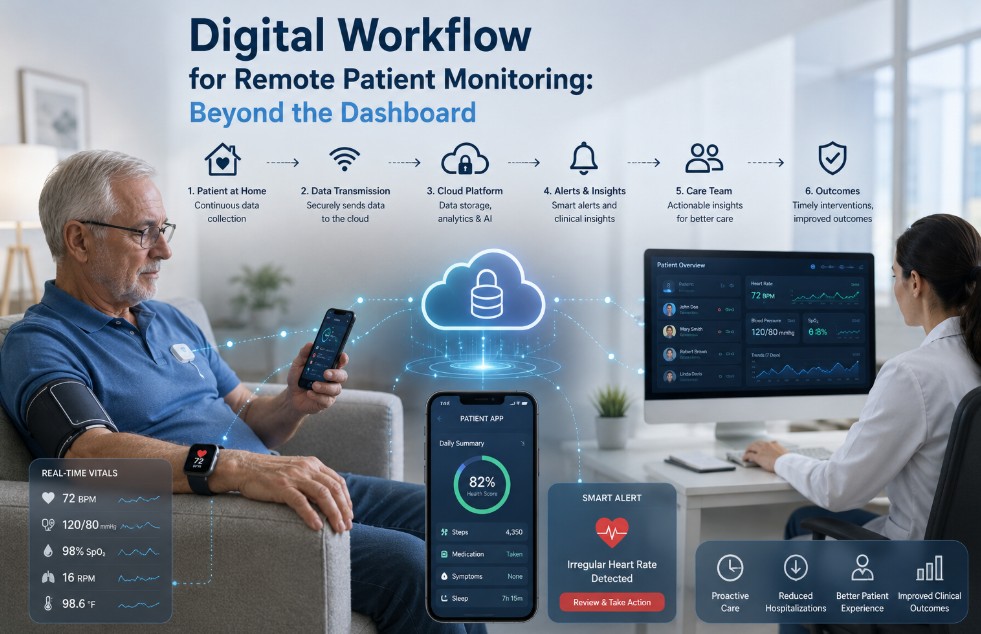
Digital workflow, in the context of Remote Patient Monitoring, is the orchestrated sequence of automated and human steps that converts a raw physiological reading into a clinical action – or a conscious clinical decision not to act. It spans five distinct domains, each of which must be deliberately designed:
Biometric sensors, cellular-enabled devices, patient-reported outcomes (PROs), and peripheral peripherals (glucometers, pulse oximeters, BP cuffs) generate timestamped readings and transmit them securely.
An integration engine (HL7 FHIR, proprietary API, or middleware) receives, normalizes, deduplicates, and timestamps data before persisting it to a clinical data repository or RPM platform.
Configured clinical thresholds, trend algorithms, and – in mature programs – machine learning models classify each reading as routine, watch, or alert. Context (patient baseline, medication changes, recent visits) modifies the classification.
A clinical care team (RN, MA, or physician depending on alert severity) reviews queued alerts, acts through structured protocols, and documents the encounter in the EHR – triggering CPT billing codes where applicable.
Automated messaging, telehealth escalation paths, and care plan updates close the loop with the patient – and feed adherence and outcome data back into Layer 3 to improve future triage accuracy.
The reason most RPM programs underperform is not a Layer 1 or Layer 2 problem. It is a Layer 3-to-4 handoff problem: the moment a machine hands off a prioritized alert to a human, and that human has no clear protocol, no staffing support, and no time budget to respond within a clinically meaningful window.
The seven-phase operational workflow, mapped precisely
Let me walk through the operational workflow the way I design it for health systems – not as a vendor’s marketing slide, but as a living process with named owners, handoffs, and failure modes.
Patient Onboarding
The workflow begins before the first reading. Enrollment triggers device provisioning (shipping or in-office setup), a structured baseline session where the patient’s normal vitals range is captured over 7–14 days, and digital literacy screening. This baseline is the anchor for every future threshold calculation. Programs that skip structured baseline capture end up with population-level thresholds that fire constantly for some patients and miss genuine deterioration in others.
Sensor Layer
Devices transmit readings on a configured schedule (typically 1–4 times daily, depending on condition acuity). The workflow must include automated connectivity checks: if a patient’s device has not transmitted within the expected window, a non-transmission alert must surface in the care team queue – because silence in an RPM program is a clinical event, not an absence of events. This is among the most overlooked design elements.
Data Layer
Raw readings pass through a validation pipeline: anomaly detection for sensor malfunction (a BP reading of 40/20 is a device error, not a patient state), unit normalization, and enrichment with contextual flags – recent medication changes pulled from the EHR, upcoming procedure dates, seasonal baselines. This enrichment is what separates an intelligent platform from a dumb data pipe. FHIR R4 has meaningfully simplified this integration layer, though mapping between vendor proprietary schemas and FHIR Observation resources remains nontrivial.
Intelligence Layer
The rules engine applies three tiers of logic: static thresholds (the floor and ceiling set at enrollment), trend thresholds (a 10 mmHg upward drift in systolic BP over three days, regardless of absolute value), and predictive flags generated by trained models for conditions like CHF decompensation or COPD exacerbation. The output is a prioritized work queue – not a flat list of alerts – organized by acuity, time-sensitivity, and patient risk tier. Mature programs integrate the risk stratification model directly into the alert queue sort order.
Clinical Layer
This is the highest-stakes phase and the one where workflow design decisions have the most direct patient impact. The care team – whose composition varies by alert tier – reviews the alert alongside the patient’s longitudinal trend, opens a structured triage note, and selects a response pathway: no action required with documentation, patient outreach by message or call, medication adjustment request to the prescribing physician, or emergency escalation. Each pathway has a defined time-to-response standard (e.g., Tier 1 alerts: response within 60 minutes). Response actions trigger automatic documentation mapped to billable CPT codes (99457, 99458, 99091).
Patient Layer
Automated patient messaging runs in parallel with clinical triage. A patient whose blood glucose is trending high receives a contextual push notification with a scripted coaching message before the care team has even reviewed the alert. For non-urgent findings, automated weekly summaries (“Your blood pressure has been well-controlled this week”) sustain engagement between clinical touchpoints. Escalated alerts trigger a video or phone encounter request through the integrated telehealth module. The engagement layer is not a nice-to-have – patient adherence to device use drops by roughly 40% in programs without structured engagement touchpoints.
Analytics Layer
The workflow closes with a feedback loop that most programs treat as a quarterly reporting task rather than an operational tool. Daily and weekly dashboards should surface alert resolution time by tier, false-positive rate by alert type, patient adherence by device and condition cohort, time-to-escalation for Tier 1 events, and billing yield per enrolled patient. These metrics are the operational heartbeat of the program. When the false-positive rate on a particular alert rule exceeds 60%, the rule needs recalibration – not next quarter, but this week.
The challenges no vendor slide deck will show you
RPM workflow design confronts a set of operational tensions that are real, persistent, and rarely documented honestly. Here are the most consequential ones – alongside the design patterns I have seen work.
Alert fatigue at scale. A 500-patient hypertension program with poorly calibrated thresholds can generate 300+ alerts per day. Clinical staff stop triaging meaningfully within weeks.
Implement patient-specific thresholds from the baseline period, a trend-suppression rule (don’t alert on the same type of finding twice in 4 hours without change), and a weekly rule recalibration cycle with the clinical lead.
EHR integration gaps. Most RPM platforms connect to one or two major EHRs well and treat everything else as a manual workaround. This breaks the longitudinal context that makes triage meaningful.
Prioritize FHIR-native platforms or those with a documented middleware layer (Redox, Rhapsody, Mirth). Define a minimum viable context dataset – medications, diagnoses, recent labs – and verify bi-directional write-back at contract stage.
Digital literacy and device adherence. Patients who most need RPM – elderly, multi-morbid, socially isolated – are often least equipped to operate the technology reliably.
Design a stratified onboarding path: cellular-only devices for low-literacy patients (no smartphone required), structured 30-day support check-ins, and a designated patient navigator role separate from the clinical triage team.
Reimbursement complexity. CMS RPM codes (99453, 99454, 99457, 99458) have specific time and device transmission requirements that are easy to fail silently if the workflow doesn’t track them automatically.
Embed billing eligibility logic into the clinical workflow – automated monthly tracking of device transmission days, care management time accrual per patient, and a billing readiness flag visible to the care coordinator before month-end close.
“The RPM program that generates the most data is not the one that saves the most lives. The one with the most disciplined clinical response workflow is. Technology enables scale; workflow determines outcome.”
Where AI and machine learning actually fit – and where they do not
There is enormous enthusiasm in the industry for AI-powered RPM – and some of it is genuinely earned. But I have watched organizations defer critical workflow design work because they were waiting for their AI vendor’s model to “figure it out.” That is a dangerous organizational pattern.
Here is where AI earns its place in RPM workflow design:
- Predictive early warning models – LSTM and gradient-boosted models trained on longitudinal biometric sequences have demonstrated meaningful sensitivity for CHF decompensation (detecting subtle weight and heart rate patterns 48–72 hours before a symptomatic event). This is real clinical utility.
- Alert prioritization and queue ordering – AI can rank the clinical urgency of a mixed alert queue far more accurately than static sort rules, especially when patient-level features (comorbidities, prior hospitalization pattern, medication adherence history) are included as model features.
- Anomaly detection for device malfunction – Statistical models that distinguish physiological anomalies from sensor artifacts reduce false-positive alert rates substantially in the first validation phase.
- Natural language processing for PRO analysis – When patients submit symptom journals or text-based check-ins, NLP can extract structured clinical signals (dyspnea, pain score, fatigue level) and incorporate them into the triage score.
- Engagement personalization – Recommendation models that adjust the timing, channel, and content of patient-facing messages based on historical engagement patterns improve adherence measurably.
Where AI does not belong yet – or belongs only with extreme caution – is in autonomous clinical decision-making without a human review step. Every AI-generated recommendation in an RPM workflow must have a defined human checkpoint. Not because AI models cannot be accurate, but because the liability structure, the regulatory framework (FDA Software as a Medical Device guidance), and – most importantly – the trust relationship with the patient require it.
Staffing the workflow: the human architecture
No digital workflow operates without a staffing model. The most common mistake is treating RPM staffing as an addendum to an existing care team’s responsibilities. Monitoring a panel of 200–500 patients requires dedicated capacity.
The three-tier RPM clinical staffing model
Tier 1 — Medical Assistants or Health Coaches handle routine reading review, non-transmission follow-up, and automated message escalation acknowledgment. One FTE per 150–200 enrolled patients in a chronic disease management program.
Tier 2 — Licensed Practical Nurses or Registered Nurses handle Tier 2 alerts requiring clinical interpretation, medication adherence coaching, and care plan adjustment coordination. One FTE per 300–400 patients, assuming a well-functioning Tier 1 filter.
Tier 3 — Physician or Advanced Practice Provider review is triggered by Tier 1 alerts (critical values), complex clinical judgment calls, and authorization of medication or care plan changes. This tier should be consuming no more than 15–20% of their time on RPM if the upstream tiers are functioning correctly.
Critically, every tier must have documented response time standards, a backup escalation path when the primary responder is unavailable, and a weekly operational huddle where alert volume, false-positive rates, and adherence trends are reviewed. The huddle is not optional — it is how workflow calibration happens in real time.
Implementation sequencing: how to stand up RPM workflow without chaos
The implementation sequence matters as much as the design. Here is the phased approach I recommend:
Foundation: workflow design, tool configuration, and staff training
Define patient eligibility criteria and enrollment workflow. Configure the RPM platform with your EHR’s patient data. Build your alert threshold library (start conservative — you can always loosen thresholds; you cannot easily claw back a staff team that has been trained to ignore frequent alerts). Complete all staff training and simulate 50 alert scenarios in a test environment before go-live.
Controlled launch: 50–100 patients, intensive monitoring
Enroll your first cohort from a single care team or condition group. Run daily operational check-ins. Track every alert to resolution. Identify your top five sources of false-positive alerts and recalibrate within the first 30 days. Do not expand enrollment until your median alert-to-resolution time meets your defined standard.
Scale: systematic expansion with performance gates
Expand enrollment in cohorts of 50–100 patients, with a defined performance gate at each expansion point (alert resolution time, adherence rate, billing yield per patient). Introduce advanced analytics capabilities — trend reporting, cohort comparison, predictive model integration — once the foundational workflow is stable. Do not let technology ambition outpace operational maturity.
The governance layer: what keeps it all from drifting
RPM workflows do not stay calibrated on their own. Without active governance, alert thresholds drift (often becoming more permissive as staff push back on alert volume), staffing ratios erode as the program grows without commensurate headcount, and documentation quality degrades as teams cut corners on structured triage notes.
Governance for RPM workflow requires three structural elements:
- A named clinical program director — accountable for clinical protocol currency, staff competency, and outcome measurement. This is not a collateral duty; it requires dedicated time allocation.
- A monthly operational performance review — with defined KPIs reviewed against targets: enrolled patient count and monthly growth rate, device transmission adherence rate (target: >85% of enrolled patients transmitting at least 16 days per month), alert resolution time by tier, clinical outcome measures (ER utilization, hospitalization rate, HbA1c trends for diabetes cohorts), and billing yield per enrolled patient per month.
- A quarterly clinical protocol review — where alert threshold logic is reviewed against false-positive rates and clinical outcome data, updated against new evidence, and recommunicated to the care team. This is the mechanism by which the program learns.
A note on interoperability, data privacy, and the regulatory landscape
RPM workflow operates within a tightening regulatory environment that project managers must track actively. Several dimensions deserve explicit attention:
HIPAA and data security: All data transmission from device to platform to EHR must be encrypted in transit and at rest. Business Associate Agreements must cover every vendor in the data flow, including the device manufacturer, the RPM platform, the telehealth tool, and any analytics layer. This is not negotiable and should be verified at contract stage, not implementation stage.
FDA SaMD (Software as a Medical Device): If your RPM platform’s AI model is making or supporting clinical decisions (not just facilitating data capture), it likely falls under the FDA’s Digital Health Software Precertification framework or requires 510(k) clearance. Verify your vendor’s regulatory status before building clinical protocols that depend on their algorithmic outputs.
CMS billing compliance: RPM billing under Medicare requires the ordering physician to have an established patient relationship, documented informed consent, a minimum of 16 days of device data per month for 99454, and careful time-tracking for 99457 and 99458. Build these requirements into the workflow as automated checkpoints, not manual audit tasks.
State-level RPM regulations: Several states have enacted RPM-specific regulations governing licensure requirements for monitoring clinical staff, consent documentation language, and scope of practice for non-physician practitioners performing remote triage. This landscape is evolving and requires annual review.
The operational truth about RPM in 2025 and beyond
Remote Patient Monitoring has crossed the threshold from pilot program to strategic imperative. Payers are expanding RPM coverage. Health systems are under structural pressure to manage chronic disease populations outside expensive acute care settings. And patients — particularly those managing hypertension, diabetes, heart failure, and COPD — have demonstrated a willingness to engage with monitoring programs when those programs are designed to be responsive and comprehensible.
The technology to support this has largely matured. Cellular-enabled devices, robust RPM platforms, FHIR-based interoperability, and validated predictive models are available from multiple vendors at accessible price points. The constraint is no longer technological. The constraint is operational.
“The future of RPM is not smarter devices. It is smarter operational design — workflows that convert continuous data into timely, human, and clinically meaningful responses. That design work cannot be automated. It has to be led.”
If you are standing up an RPM program, the most valuable investment you can make in the first 90 days is not in the technology stack — it is in the clinical workflow design, the staffing model, and the governance structure that will determine whether your technology investment generates outcomes or generates dashboards.
The patients in your program are not metrics. They are people managing serious chronic conditions, often alone, often anxious, often uncertain whether anyone is watching. When the workflow is right, someone always is.