


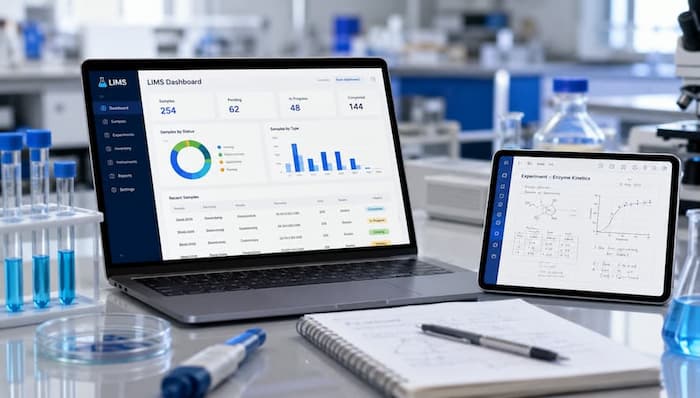
Digitizing science. Accelerating discovery
Laboratories are no longer only places of scientific experimentation.
Today’s laboratories generate massive volumes of structured and unstructured information across research, diagnostics, pharmaceuticals, biotechnology, and healthcare operations.
Managing that information efficiently is now critical.
This is where Electronic Lab Notebook (ELN) and Laboratory Information Management System (LIMS) become essential.
For professionals entering healthcare technology, pharmaceuticals, laboratory informatics, project management, or digital transformation initiatives, understanding ELN and LIMS provides a foundational advantage.
This guide explains what they are, how they differ, implementation considerations, and lessons learned from leading such programs in regulated environments.
What is an Electronic Lab Notebook (ELN)?
An Electronic Lab Notebook is the digital evolution of a traditional laboratory notebook.
Scientists and researchers use ELNs to document:
- Experimental procedures
- Observations
- Scientific notes
- Protocol execution
- Research findings
- Calculations
- Analytical results
ELNs help researchers maintain structured, searchable, and traceable experiment records.
Instead of maintaining handwritten records, users can securely document and retrieve information electronically.
Think of ELN as the digital workspace of the scientist.
What is LIMS?
A Laboratory Information Management System manages operational workflows associated with laboratory processes.
LIMS typically supports:
- Sample registration
- Sample tracking
- Test workflow management
- Instrument integration
- Result management
- Quality workflows
- Reporting and analytics
LIMS focuses on operational efficiency and sample lifecycle control.
Think of LIMS as the operational backbone of the laboratory.
ELN vs LIMS: Understanding the Difference
Beginners often assume ELN and LIMS are interchangeable.
They are not.
Both systems solve different challenges.
| Capability | ELN | LIMS |
| Experiment documentation | Yes | Limited |
| Scientific observations | Yes | No |
| Sample tracking | Limited | Extensive |
| Workflow automation | Moderate | High |
| Laboratory operations | Limited | Strong |
| Instrument integrations | Moderate | Extensive |
| Compliance support | Yes | Yes |
A simplified explanation:
ELN captures scientific work.
LIMS manages laboratory operations.
Modern organizations frequently integrate both systems.
Why Laboratories Need ELN and LIMS
As laboratories grow, manual systems create challenges such as:
- Duplicate data entry
- Missing records
- Delayed reporting
- Limited visibility
- Traceability gaps
- Compliance risks
Digital laboratory platforms help solve these issues by creating connected and automated environments.
Benefits include:
Improved sample traceability
Track samples from receipt through completion.
Enhanced data integrity
Reduce manual transcription errors.
Faster workflow execution
Automate repetitive activities.
Better compliance readiness
Support audit and validation requirements.
Increased operational visibility
Provide real-time reporting and laboratory metrics.
Key Components of ELN and LIMS Solutions
1. Sample Lifecycle Management
Supports:
- Sample registration
- Barcode assignment
- Chain-of-custody tracking
- Status monitoring
2. Experiment Documentation
Captures:
- Procedures
- Observations
- Experimental outcomes
- Research notes
3. Instrument Integration
Allows laboratory systems to communicate directly with:
- Analytical instruments
- Diagnostic devices
- Laboratory platforms
This reduces manual data transcription.
4. Inventory and Reagent Management
Tracks:
- Chemicals
- Consumables
- Reagents
- Expiry information
5. Audit Trails and Compliance Controls
Critical for regulated environments.
Includes:
- User activity logging
- Data modifications
- Electronic signatures
- Access controls
6. Reporting and Analytics
Provides visibility into:
- Laboratory productivity
- Sample turnaround time
- Quality metrics
- Operational trends
My Experience: Leading ELN and LIMS Product Development & Implementation
Laboratory technology implementation is not merely software deployment.
It requires understanding science, operations, quality expectations, and compliance frameworks.
As Senior Project Manager, my responsibilities included:
Stakeholder Discovery Sessions
Collaborating with:
- Scientists
- Laboratory analysts
- Quality teams
- Operations teams
- Regulatory stakeholders
- Technical teams
The objective was understanding laboratory workflows before defining product functionality.
Translating Laboratory Challenges into Product Requirements
Users often describe operational difficulties rather than system needs.
For example:
“Tracking sample status takes too long.”
This becomes:
“Design end-to-end sample lifecycle visibility with automated status updates.”
Strong products emerge from understanding workflow realities.
Managing GxP and Validation Requirements
Laboratory systems operating in regulated environments require strict controls.
Focus areas included:
- Requirement traceability
- Computer system validation
- Audit trails
- Role-based access management
- Data integrity practices
- Change control processes
- Validation documentation
In regulated environments, implementation success extends beyond technical delivery.
Common Challenges During ELN and LIMS Implementation
User adoption barriers
Moving from paper notebooks to digital systems requires behavioral change.
Laboratory workflow variability
Different laboratories often operate differently.
Customization requirements increase complexity.
Instrument integration challenges
Legacy laboratory equipment frequently creates interoperability difficulties.
Data migration risks
Historical scientific records require careful transition planning.
Advice for Beginners Entering Laboratory Informatics
Laboratory technology projects are unique.
Scientific workflows are often deeply specialized.
Spend time understanding:
- Why samples move through certain stages
- How scientists document experiments
- Which data is business-critical
- What compliance requirements exist
- How users interact with systems daily
Understanding operational context often reveals more value than system specifications.
Future of ELN and LIMS Platforms
The next generation of laboratory platforms is evolving through:
- Artificial Intelligence-assisted analytics
- Laboratory automation
- Cloud-native laboratory ecosystems
- IoT-enabled laboratory devices
- Predictive quality monitoring
- Advanced interoperability frameworks
- Real-time laboratory intelligence
Laboratories are transitioning from data collection environments toward intelligent scientific ecosystems.
Final Thoughts
Electronic Lab Notebooks and Laboratory Information Management Systems are not simply technology platforms.
They represent digital transformation foundations for modern laboratories.
Leading such initiatives reinforced a key lesson:
Successful laboratory solutions require balancing science, operational efficiency, compliance requirements, and user adoption.
Technology captures information.
Understanding laboratory workflows creates impact.
Know the Author
Hey there, readers! Welcome to my little corner of the internet. I ain’t just your average blogger — I’m a seasoned project manager with a knack for diving deep into research and unraveling the mysteries of project management. But that’s not all there is to me! With a background in Healthcare, IT and Pharmaceuticals for Project management, hospital management and a passion for travel, hiking, and trekking, I’m all about blending the professional with the adventurous. So, join me on this voyage where we’ll explore the ins and outs of strategy, project management and share tales from the management, travels, and maybe even swap tips along the way.
Feel free to visit my site to know more about my researched output in the form of blogs: http://www.virsafeed.com/
Would you like to connect with me? Please drop me an email at virsafeed.com@gmail.com