


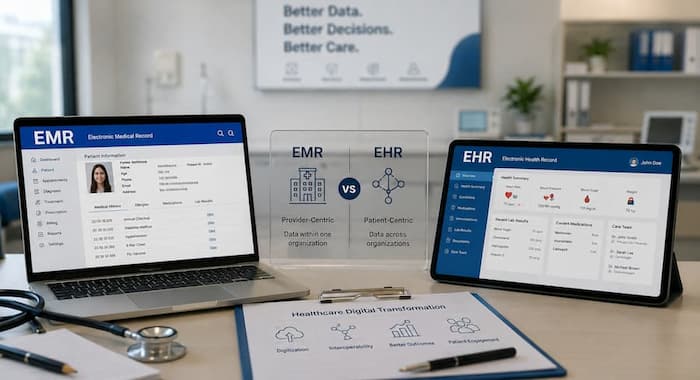
Connected health begins with connected records.
Healthcare data is growing faster than ever.
Every consultation, diagnosis, medication, laboratory result, clinical observation, and treatment plan generates valuable information.
The challenge is not creating data.
The challenge is making that information accessible, accurate, secure, and actionable.
That is where Electronic Medical Records (EMR) and Electronic Health Records (EHR) become essential.
If you are beginning your journey in healthcare technology, healthcare IT, business analysis, product management, or project delivery, understanding EMR and EHR systems is foundational knowledge.
This guide explains what they are, how they differ, implementation considerations, and lessons from leading these healthcare transformation initiatives.
What is an Electronic Medical Record (EMR)?
An Electronic Medical Record is a digital version of a patient chart maintained within a single healthcare organization.
It includes:
- Medical history
- Diagnoses
- Medications
- Treatment records
- Physician notes
- Laboratory results
- Immunization history
- Allergies
EMR replaces paper records inside one healthcare setting.
Think of EMR as a digital patient file used internally.
What is an Electronic Health Record (EHR)?
An Electronic Health Record expands beyond internal documentation.
EHR creates a broader patient-centered ecosystem where health information can be securely shared across healthcare providers and systems.
EHR typically includes:
- Cross-provider patient information
- Care coordination records
- Laboratory integrations
- Diagnostic imaging data
- Referral management
- Interoperability capabilities
While EMR often remains organization-specific, EHR supports information exchange across healthcare ecosystems.
EMR vs EHR: Understanding the Difference
Many beginners use EMR and EHR interchangeably.
However, there are important distinctions.
| Feature | EMR | EHR |
| Scope | Internal organization | Multiple organizations |
| Data Sharing | Limited | Extensive |
| Interoperability | Minimal | High |
| Care Coordination | Limited | Strong |
| Cross-provider visibility | No | Yes |
A practical way to understand it:
EMR digitizes records.
EHR connects healthcare.
Why EMR/EHR Systems Matter Today
Healthcare organizations face increasing pressure to:
- Improve patient outcomes
- Reduce documentation burden
- Increase efficiency
- Enable coordinated care
- Strengthen compliance
- Support data-driven decisions
Manual documentation systems create:
- Data silos
- Duplicate work
- Delayed information access
- Increased risk of errors
EMR/EHR platforms solve these challenges by centralizing information.
Key Components of an EMR/EHR Platform
1. Patient Demographics Management
Captures:
- Personal information
- Contact details
- Insurance information
- Medical identifiers
2. Clinical Documentation
Supports:
- Physician notes
- Progress documentation
- Nursing workflows
- Encounter records
3. Medication Management
Includes:
- Prescriptions
- Drug history
- Allergy alerts
- Medication reconciliation
4. Laboratory Integration
Enables:
- Test ordering
- Sample tracking
- Report retrieval
- Diagnostic visibility
5. Clinical Decision Support
Advanced systems provide:
- Alerts
- Recommendations
- Drug interaction warnings
- Risk indicators
6. Reporting and Analytics
Healthcare leadership requires visibility into:
- Disease patterns
- Clinical performance
- Patient outcomes
- Resource utilization
My Experience: Leading EMR/EHR Development and Implementation
Developing healthcare technology requires much more than building screens and workflows.
As Senior Project Manager leading product development and implementation activities, my involvement included:
Stakeholder Discovery Workshops
Collaborating with:
- Physicians
- Nursing teams
- Clinical administrators
- Quality stakeholders
- IT teams
- Leadership groups
The goal was understanding operational reality before defining system functionality.
Translating Clinical Language into Product Requirements
Healthcare users rarely communicate in technical specifications.
Instead, they express workflow pain points:
“Patient history takes too long to retrieve.”
The responsibility becomes translating this into:
“Create centralized patient timeline functionality with search and filtering capability.”
Good healthcare products begin with understanding user workflows.
Managing GxP and Compliance Requirements
Healthcare technology in regulated environments requires robust controls.
Critical areas included:
- Requirement traceability
- User access management
- Electronic signatures
- Audit trails
- Validation strategy
- Change management
- Data integrity controls
Implementation success depends equally on compliance and usability.
Common Challenges During EMR/EHR Implementation
User resistance
Clinical staff often face heavy workloads.
New technology adoption can initially feel disruptive.
Workflow variability
Clinical processes differ significantly across organizations.
Standardization becomes challenging.
Data migration complexity
Historical patient records require careful transition.
Interoperability limitations
Legacy systems frequently create integration challenges.
Advice for Beginners Entering Healthcare Technology
Healthcare systems are fundamentally different from traditional enterprise software.
In healthcare:
Users are busy.
Processes are critical.
Mistakes can affect patient care.
Technology exists to support people—not replace them.
Before gathering requirements, ask:
- Why does this workflow exist?
- Who depends on it?
- What risks emerge if information is delayed?
- How does the patient experience change?
These questions often reveal the true business need.
Future of EMR and EHR Systems
Healthcare technology is rapidly evolving through:
- Artificial Intelligence-assisted documentation
- Voice-enabled clinical notes
- Predictive analytics
- Population health management
- Interoperability standards
- Cloud healthcare ecosystems
- Real-time patient monitoring
The future of EMR/EHR is shifting from digital record storage toward intelligent healthcare ecosystems.
Final Thoughts
EMR and EHR systems represent more than software implementation projects.
They are healthcare transformation initiatives.
Leading these programs reinforced one lesson repeatedly:
Successful healthcare technology requires balancing clinical workflows, compliance expectations, operational realities, and human adoption.
Technology creates possibilities.
Understanding healthcare creates impact.
Know the Author
Hey there, readers! Welcome to my little corner of the internet. I ain’t just your average blogger — I’m a seasoned project manager with a knack for diving deep into research and unraveling the mysteries of project management. But that’s not all there is to me! With a background in Healthcare, IT and Pharmaceuticals for Project management, hospital management and a passion for travel, hiking, and trekking, I’m all about blending the professional with the adventurous. So, join me on this voyage where we’ll explore the ins and outs of strategy, project management and share tales from the management, travels, and maybe even swap tips along the way.
Feel free to visit my site to know more about my researched output in the form of blogs: http://www.virsafeed.com/
Would you like to connect with me? Please drop me an email at virsafeed.com@gmail.com