

Better data capture. Better research. Better patient outcomes
Electronic Data Capture (EDC) has become a foundational technology in modern clinical research. As clinical trials grow more complex, more global, and more data-driven, sponsors and research teams need systems that can collect, manage, validate, and review trial data with speed and accuracy. An EDC system provides exactly that. It replaces paper-based processes with structured electronic workflows that support better data quality, faster decision-making, and stronger compliance.
For beginners, EDC can seem like just another clinical software term. In reality, it is one of the most important digital enablers in a clinical trial. It sits at the center of study data collection, helping site teams enter information, data managers review it, monitors check it, and sponsors analyze it. In a regulated environment, especially one governed by GxP principles, EDC is not only about convenience. It is about control, traceability, and trust.
What is Electronic Data Capture?
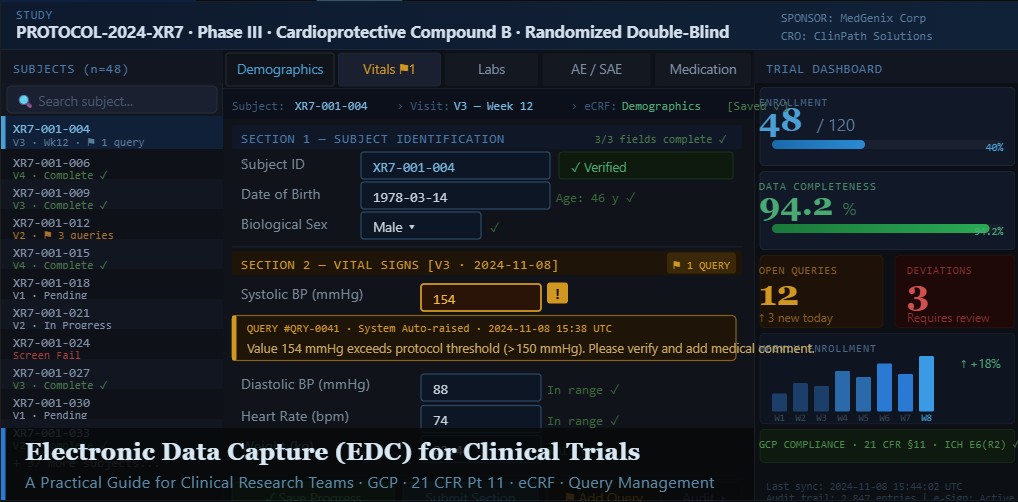
Electronic Data Capture is a software system used to collect clinical trial data electronically, usually through electronic case report forms, also called eCRFs. Instead of writing information on paper and later entering it into a database, investigators and site staff enter it directly into a secure digital platform. The system then stores that data in a structured way that can be reviewed, queried, cleaned, and analyzed.
At its core, EDC is designed to make clinical data management more efficient and more reliable. It reduces manual transcription, standardizes data entry, and provides a controlled environment for trial documentation. This is especially valuable in multicenter and multinational studies, where consistency across sites is essential.
Why EDC matters in clinical trials
Clinical trials depend on high-quality data. Every endpoint, safety event, protocol deviation, and outcome measure must be captured accurately. If the data is incomplete or inconsistent, it can delay analysis, affect study quality, and weaken regulatory confidence. EDC helps address these risks by building structure into the data collection process from the start.
One of the biggest benefits of EDC is speed. Because data is entered electronically, it becomes available almost immediately for monitoring and review. This allows study teams to identify issues earlier, send queries faster, and resolve data discrepancies before they grow into larger problems. In traditional paper-based systems, those same steps can take much longer.
EDC also improves visibility. Sponsors and CROs can track study progress in real time, review data trends, and monitor site performance more effectively. That level of oversight is especially important in larger trials, where manual processes would be too slow and fragmented to support timely action.
How EDC works
A typical EDC workflow begins at the clinical site. The investigator or site coordinator collects patient information during visits and enters the data into the eCRF within the EDC system. The platform may include validation rules that check for missing fields, out-of-range values, or inconsistent entries.
If something appears incorrect or incomplete, the data manager or clinical research associate can raise a query. The site then reviews the issue, makes corrections if needed, and responds through the system. This creates a documented cycle of data review and resolution. Once the data is finalized, it can be locked and prepared for statistical analysis.
This process may sound simple, but it is highly important. It creates a structured data trail that supports data integrity, auditability, and review readiness. In regulated clinical research, that structure is essential.
Key features of a good EDC system
A strong EDC platform should offer more than just electronic forms. It should support the full lifecycle of trial data management.
Some of the most important features include:
- Electronic case report forms for structured data entry.
- Real-time edit checks and validation rules.
- Query generation and resolution workflows.
- Audit trails that track every change.
- Role-based access and permissions.
- Data export for analysis and reporting.
- Source data verification support.
- Configurable study setup for different protocols.
- Secure storage and controlled user authentication.
- Integration readiness with other clinical systems.
These features make the platform useful for both operational teams and compliance teams. They also help standardize the way data is captured across different studies and sites.
EDC and compliance in GxP environments
In a GxP setting, EDC has to support more than research convenience. It must align with controlled processes, documentation standards, and quality expectations. This means the system should be implemented with careful attention to requirements, validation, testing, and change control.
A regulated trial environment typically expects:
- Traceability from requirements to implementation.
- Controlled user access.
- Data integrity and audit trail support.
- Validation evidence for intended use.
- Documented training and support processes.
- Reliable backup and recovery controls.
- Clear ownership of system administration and study setup.
For project and operations leaders, this changes the way implementation is approached. The focus is not only on functionality, but also on proving that the system performs as intended in a controlled environment. That is why EDC projects often involve close collaboration between business users, quality teams, IT teams, and clinical operations teams.
Benefits for sponsors, CROs, and sites
EDC creates value across the clinical research ecosystem.
For sponsors, it improves oversight, speeds up access to study data, and supports cleaner analysis. For CROs, it helps manage multi-site trials with better consistency and efficiency. For sites, it reduces paperwork and gives them a more organized way to enter and track patient information.
Some of the most important benefits include:
- Faster data availability.
- Better data quality.
- Easier query management.
- Improved trial oversight.
- Reduced dependency on paper documents.
- Stronger consistency across sites.
- Better readiness for audits and inspections.
When used well, EDC becomes a practical enabler of clinical trial execution rather than just a technical tool.
Challenges in EDC implementation
Despite its benefits, EDC implementation is not without challenges. One common issue is poor requirement definition. If the study design, data fields, or workflow expectations are not clearly defined up front, the system may not fully support operational needs. This can lead to rework, delays, or user frustration.
Another challenge is user adoption. Site teams and study personnel need proper training to use the system effectively. If the interface is too complicated or the training is weak, data entry quality can suffer.
Validation is another critical area. In regulated environments, the EDC system must be tested and documented to show that it works as intended. This takes time and discipline, but it is necessary for confidence and compliance.
Integration can also be challenging. Many studies require EDC to work alongside other clinical systems such as randomization tools, laboratory systems, safety databases, or eTMF platforms. Ensuring smooth data flow between systems requires thoughtful planning and technical coordination.
What beginners should understand
For someone new to clinical research, EDC can be understood as the digital backbone of trial data capture. It is the system that organizes the information collected during a study and makes that information usable for review and analysis.
A beginner should remember these simple points:
- Paper forms are replaced by electronic forms.
- Data is entered at the site into a secure system.
- Validation checks help reduce errors.
- Queries help resolve data issues.
- Audit trails support traceability.
- The cleaned data is later used for reporting and analysis.
This makes EDC one of the most practical tools in modern clinical operations.
A practical implementation view
From a senior project management perspective, an EDC implementation is a structured business and technology initiative. It begins with understanding the trial’s data collection needs, user roles, compliance obligations, and reporting expectations. Then the system is configured, tested, validated, and released with supporting documentation and training.
Successful implementation depends on strong collaboration between clinical operations, data management, quality, IT, and vendor teams. Each group brings a different perspective, and all of them matter. The best EDC projects are not just technically sound. They are also operationally realistic and user-friendly.
That is why the role of project leadership is so important. The project manager helps translate trial needs into a working system, manages timelines, coordinates stakeholders, and ensures the implementation stays aligned with quality and business goals.
Final thoughts
Electronic Data Capture has transformed how clinical trials collect and manage data. It improves speed, accuracy, oversight, and traceability while supporting better collaboration across sponsors, CROs, and sites. In GxP environments, it also helps reinforce the discipline and control needed for compliant operations.
For beginners, EDC is best understood as the digital system that brings structure to trial data. For experienced clinical teams, it is a critical part of trial execution and quality. For project leaders, it is a solution that must be planned carefully, implemented responsibly, and supported throughout its lifecycle.
As clinical research continues to evolve, EDC will remain central to efficient, reliable, and compliant trial operations. The organizations that use it well will be better positioned to manage complexity, maintain data integrity, and deliver studies with confidence.
Know the Author
Hey there, readers! Welcome to my little corner of the internet. I ain’t just your average blogger — I’m a seasoned project manager with a knack for diving deep into research and unraveling the mysteries of project management. But that’s not all there is to me! With a background in Healthcare, IT and Pharmaceuticals for Project management, hospital management and a passion for travel, hiking, and trekking, I’m all about blending the professional with the adventurous. So, join me on this voyage where we’ll explore the ins and outs of strategy, project management and share tales from the management, travels, and maybe even swap tips along the way.
Feel free to visit my site to know more about my researched output in the form of blogs: http://www.virsafeed.com/
Would you like to connect with me? Please drop me an email at virsafeed.com@gmail.com