

“Navigating the Uncharted: Tackling Unforeseen Project Challenges with VIRSAFEED Methodology”
Tired of getting the run-around?
Every minute spent listening to an upsell pitch or reviewing the details of another change order is a minute taken away from your growing to-do list. Partner with someone who prioritizes your project over paperwork.
The below strategy was framed out of passion while sitting in a glass cabin with team at 18 degree (with power chill) Celsius while the real temperature outside was 47 degree. The continuous process of juggling with single to multiple Projects and Deployments for Life Sciences, Pharmaceuticals, Healthcare, Medical Emergencies, Labs, Medical Imaging and other verticals of services.
Challenges were limitless while working with a cross functional team of multiple projects in various technology with various skill sets of folks from different walks of life and varied mindsets of course and to bring a strong strategy was in most demand to bring Projects up and running and getting implemented was in need of a crafted strategy or to call it a get stuff done strategy.
V: Visionary
I: Innovative
R: Resilient
S: Strategic
A: Agile
F: Focused
E: Efficient
E: Effective
D: Dynamic
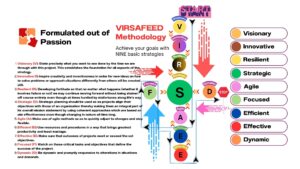
Description of the Diagram
- Visionary (V): State precisely what you want to see done by the time we are through with this project. This establishes the foundation for all aspects of the strategy.
- Innovative (I): Inspire creativity and inventiveness in order for new ideas on how to solve problems or approach situations differently from others will be created still.
- Resilient (R): Developing fortitude so that no matter what happens (whether it involves failure or not) we may continue moving forward without being shaken off course entirely even though at times hurdled by misfortunes along life’s way.
- Strategic (S): Strategic planning should be used so as projects align their objectives with those of an organization thereby making them an integral part of its overall mission statement by using coherent approaches which are based on aim effectiveness even though changing in nature all time long.
- Agile (A): Make use of agile methods so as to quickly adjust to changes and stay flexible.
- Efficient (E): Use resources and procedures in a way that brings greatest productivity and least wastage.
- Effective (E): Make sure that outcomes of projects meet or exceed the set objectives.
- Focused (F): Watch on those critical tasks and objectives that define the success of the project.
- Dynamic (D): Be dynamic and promptly responsive to alterations in situations and demands.
This self-framed strategic structure emphasizes a top-down approach starting with a visionary outlook, incorporating innovation, resilience, and strategic planning at its core, while remaining agile, efficient, effective, focused, and dynamic throughout the project lifecycle.
The inception of the drill strategy started resonating of course from the time I spent in barrack quarters while joining voluntarily with military folks and learning the skills and strategies from daily drills, be it a planned or an unplanned drills and then moving out to the corporate culture with challenges. Managing a single project and single client to managing multiple projects with multiple stakeholder’s matrices with a touch of perfection and harmony was the epitome of the overall plan and strategy.
While managing a project, “Frustrated by going around in circles?” generally stands for the irritation that emanates from unclear communication, decision-making or accountability mechanisms. It may be disappointing when assignments keep on changing hands without advancing from one stage to another, or when unproductive conversations keep going round in a circle without definite steps being taken.
This can be combated by having the project manager aim at having an environment that is well ordered to make it also much easier because in this way all things would have been made clear thus enhancing performance among an interactive team resulting from greater levels while displaying more effectiveness in return (eg., higher productivity in fewer hours). Strategic plans help maintain this concentration even amid change where else defining parameters guide people about what should happen next so that they feel belonged based on what has transpired between them since each moment counts then projects become aligned not leaving anyone behind other than working together as one body towards achieving what was set out. Through Open communication paths that will make everyone contribute towards achievement.
Strategic Structure:
- A self-framed strategic structure is emphasized for every project or stakeholder. One size fits all might not work with routine processes.
- It starts with a top-down approach.
- Incorporates elements like visionary outlook, innovation, resilience, and strategic planning.
- Remains agile, efficient, effective, focused, and dynamic throughout the project lifecycle.
Inception of the Drill Strategy:
- Inspired by military drills during time spent in barrack quarters or in campings during hiking and night treks.
- Transitioned to corporate culture with challenges.
- Managing single projects to multiple projects with stakeholder matrices.
Addressing Frustration and Unclear Communication:
“Frustrated by going around in circles?” refers to unclear communication, decision-making, or accountability issues.
- Combat this by having a well-ordered environment.
- Clear communication enhances performance.
- Strategic plans maintain concentration even amid change.
- Defining parameters guide people toward next steps.
- Open communication paths foster contribution and alignment.