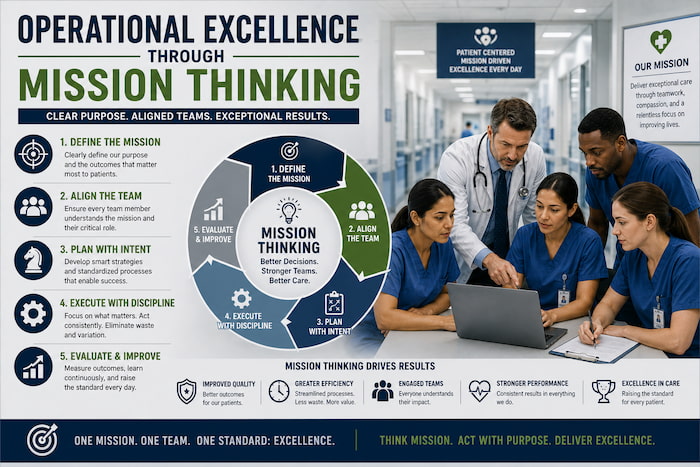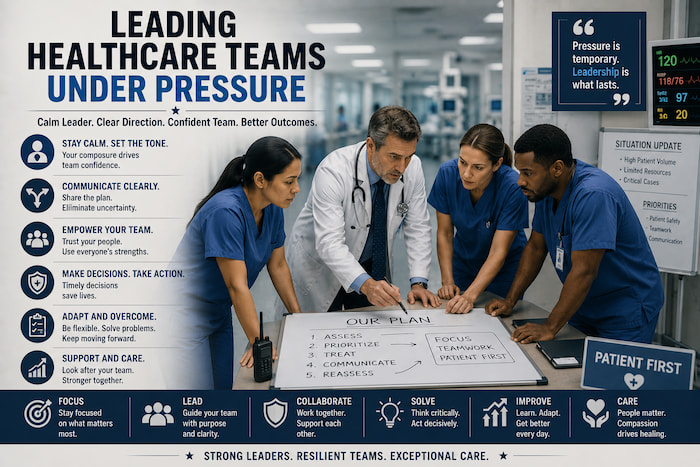


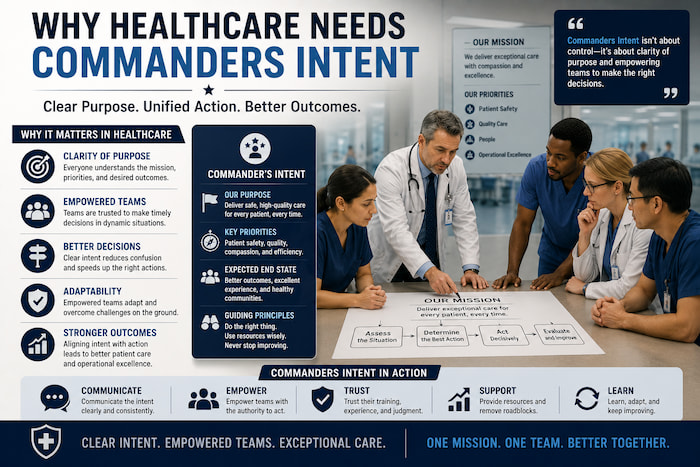
Plans fail. Intent endures.
Of everything I have borrowed from military practice across thirteen years years in healthcare operations, the single most powerful idea is commander’s intent. It is deceptively simple and quietly transformative. Commander’s intent is a clear statement of what the operation is trying to achieve and why, given so that when the plan meets reality and falls apart, as every plan eventually does, the people on the ground can improvise toward the right outcome instead of freezing or following a script that no longer fits. Healthcare needs this more than almost any other field, and has it almost nowhere.
Plans Fail; Intent Endures
Every experienced operator knows that no plan survives contact with reality intact. The situation shifts, the assumptions break, the unexpected arrives. A team that has only been given a rigid plan is paralysed the moment reality departs from it, because they were told what to do but never why. A team that understands the intent behind the plan can adapt, because they grasp the purpose and can find a new route to it when the old one is blocked. In healthcare, where every patient is a fresh set of variables and the script is always slightly wrong, intent is what lets people respond intelligently instead of mechanically.
Tell People Why, Not Just What
The practical heart of commander’s intent is a relentless commitment to explaining the why. When a protocol is introduced, the disciplined leader does not merely instruct people to follow it. They explain what the protocol is for, what outcome it protects, and what matters most when it cannot be followed to the letter. This matters enormously because protocols cannot cover every situation, and the patient who does not fit the protocol is exactly the one most at risk. A nurse who understands the purpose behind a rule can make a sound judgment when the rule does not apply. A nurse who only knows the rule cannot, and the patient pays for the gap.
Intent Enables Decentralised Decisions
Healthcare decisions are made at the bedside, by the person in the room, in the moment, and they cannot all be escalated upward without the system grinding to a halt. This is precisely the problem commander’s intent was designed to solve. By making the objective and its reasoning genuinely clear, a leader empowers people far from the centre to make decisions that align with the mission without waiting for permission. This is faster, more resilient, and more respectful of frontline expertise than any command-and-control model. The leader’s job becomes setting clear intent and then trusting trained people to pursue it, rather than approving every decision personally.
How to Give Clear Intent
Good intent is specific about the purpose and the priorities while leaving the method open. It says what we are trying to achieve, why it matters, and what must hold true even if everything else has to change, and then it deliberately leaves the how to the judgment of the people doing the work. For a discharge team it might be that the priority is getting every medically fit patient home safely today, that this matters because people recover better at home and someone sicker needs the bed, and that safety must never be sacrificed for speed. Given that, the team can handle a hundred situations no rulebook could anticipate, all of them pulling in the same direction. That is the quiet power of intent, and it is exactly what healthcare has been missing.
Hey there, readers! Welcome to my little corner of the internet. I ain’t just your average blogger — I’m a seasoned project manager with a knack for diving deep into research and unraveling the mysteries of project management. But that’s not all there is to me! With a background in Healthcare, IT and Pharmaceuticals for Project management, hospital management and a passion for travel, hiking, and trekking, I’m all about blending the professional with the adventurous. So, join me on this voyage where we’ll explore the ins and outs of strategy, project management and share tales from the management, travels, and maybe even swap tips along the way.
Feel free to visit my site to know more about my researched output in the form of blogs: http://www.virsafeed.com/
Would you like to connect with me? Please drop me an email at virsafeed.com@gmail.com